2.6. COMPOSICIÓN DE TRANSFORMACIONES LINEALES E IDENTIDAD: definiciones y propiedades

Por Jennyfer Paulina Bennetts Castillo

(Trabajo de titulación asesorado por la Dra. Diana Avella Alaminos)

INTRODUCCIÓN

Cuando preparamos un platillo para comer, podemos simplificar diciendo el nombre, pero no es tan simple como suena, en realidad tuvimos que seguir una serie de pasos, una receta en cierto orden
Pues así sucede con la composición de transformaciones

COMPOSICIÓN DE TRANSFORMACIONES LINEALES

Definición: Sean $U,V,W$ $K$ – espacios vectoriales y $T\in\mathcal{L}(V,W)$, $S\in\mathcal{L}(W,U)$. Definimos la composición de $S$ con $T$ como $S\circ T:V\longrightarrow U$ donde $\forall v\in V((S\circ T)(v)=S(T(v)))$

Ejemplos

  • Sean $T_1 , T_2 \in \mathcal{L}(\mathbb{R}^2 , \mathbb{R}^2)$ definidas para todo $(x,y) \in \mathbb{R}^2$ como:
    $T_1 (x,y) = (3x , 3y)$
    $T_2 (x,y) = (-y , x)$
    $(T_1 \circ T_2)(x,y) = (-3y , 3x) = (T_2 \circ T_1)(x,y)$

Justificación. Sea $(x,y) \in \mathbb{R}^2$

$(T_1 \circ T_2)(x,y) = T_1 (T_2 (x,y) )$ $= T_1 (-y , x) = (-3y , 3x)$

$(T_2 \circ T_1)(x,y) = T_2 (T_1 (x,y) )$ $= T_2 (3x , 3y) = (-3y , 3x)$

  • Sean $T_1 , T_2 \in \mathcal{L}(\mathbb{R}^2 , \mathbb{R}^2)$ definidas para todo $(x,y) \in \mathbb{R}^2$ como:
    $T_1 (x,y) = (y , x)$
    $T_2 (x,y) = (x , 2y)$
    $(T_1 \circ T_2)(x,y) = (2y , x)$
    $(T_2 \circ T_1)(x,y) = (y , 2x)$

Justificación. Sea $(x,y) \in \mathbb{R}^2$

$(T_1 \circ T_2)(x,y) = T_1 (T_2 (x,y) )$ $= T_1 (x , 2y) = (2y , x)$

$(T_2 \circ T_1)(x,y) = T_2 (T_1 (x,y) )$ $= T_2 (y , x) = (y , 2x)$

Teorema (2.6.1.): La composición de transformaciones lineales es lineal.

Demostración: Sean $U,V,W$ $K$ – espacios vectoriales y $T\in\mathcal{L}(V,W)$, $S\in\mathcal{L}(W,U)$.

P.D. $S\circ T\in\mathcal{L}(V,U)$.

Sean $x,y\in V$ y $\lambda\in K$.
Entonces $(S\circ T)(\lambda x + y)=S(T(\lambda x + y))$$=S(\lambda T(x) + T(y))=\lambda S(T(x)) + S(T(y))$$=\lambda (S\circ T)(x) + (S\circ T)(y)$.

Como $(S\circ T)(\lambda x + y)=\lambda (S\circ T)(x) + (S\circ T)(y)$, entonces $S\circ T\in\mathcal{L}(V,U)$.

Observación: La composición de transformaciones lineales es asociativa.

Proposición (2.6.2.): Sean $U,V,W$ $K$ – espacios vectoriales, $T_1, T_2\in\mathcal{L}(V,W)$ y $S_1,S_2\in\mathcal{L}(W,U)$. Se cumple que:

a) $(S_1+S_2)\circ T_1=(S_1\circ T_1)+(S_2\circ T_1)$
b) $S_1\circ (T_1+T_2)=(S_1\circ T_1)+(S_1\circ T_2)$

Demostración: Sea $v\in V$.

a) $((S_1+S_2)\circ T_1)(v)=(S_1+S_2)(T_1(v))=S_1(T_1(v))+S_2(T_1(v))$$=(S_1\circ T_1)(v)+(S_2\circ T_1)(v)=((S_1\circ T_1)+(S_2\circ T_1))(v)$

Como $\forall v\in V(((S_1+S_2)\circ T_1)(v)=((S_1\circ T_1)+(S_2\circ T_1))(v))$, entonces $(S_1+S_2)\circ T_1=(S_1\circ T_1)+(S_2\circ T_1)$.

b) $(S_1\circ (T_1+T_2))(v)=S_1((T_1+T_2)(v))=S_1(T_1(v)+T_2(v))$$=S_1(T_1(v))+S_1(T_2(v))=(S_1\circ T_1)(v) + (S_1\circ T_2)(v)$$=((S_1\circ T_1)+(S_1\circ T_2))(v)$

Como $\forall v\in V ((S_1\circ (T_1+T_2))(v)=(S_1\circ T_1)+(S_1\circ T_2))$

Observación: Si $V$ es un $K$ – espacio vectorial y definimos $T:V\longrightarrow V$ como $T(v)=v$ para toda $v\in V$, entonces $T\in\mathcal{L}(V,V)$. Porque para cualesquiera $u, v\in V$ y $\lambda\in K$ tenemos que $T (\lambda u + v)=\lambda u + v = \lambda T (u) + T (v)$.

TRANSFORMACIÓN IDENTIDAD

Definición: Sea $V$ un $K$ – espacio vectorial. Definimos la transformación identidad en $V$ como $id_V:V\longrightarrow V$ donde $\forall v\in V(id_V (v)=v)$

Observación: Sean $V,W$ $K$ – espacios vectoriales y $T\mathcal{L}(V,W)$. Se tiene que $id_W\circ T=T$ y $T\circ id_V=T$. Porque para cualquier $v\in V$ tenemos que $(id_W\circ T)(v)=id_W(T(v))=T(v)$ y $(T\circ id_V)(v)=T(id_V(v))=T(v)$.

Nota: En los cursos básicos de Cálculo se demuestra que si tenemos dos conjuntos $A$ y $B$ y una función $f:A\longrightarrow B$, entonces $f$ es invertible si y sólo si $f$ es biyectiva. Donde se define $f$ invertible como una función para la cual existe una función, denotada como $f^{-1}:B\longrightarrow A$, tal que $f^{-1}\circ f=id_A$ y $f\circ f^{-1}=id_B$.

Proposición (2.6.3.): Sean $V,W$ $K$ – espacios vectoriales y $T\in\mathcal{L}(V,W)$.
Si $T$ es invertible, entonces $T^{-1}\in\mathcal{L}(W,V)$.

Demostración: Sup. $T$ es invertible, i.e. $\exists T^{-1}:W\longrightarrow V$ tal que $T^{-1}\circ T=id_V$ y $T\circ T^{-1}=id_W$.
Entonces la Nota nos asegura que $T$ es biyectiva.

Sean $w_1,w_2\in W$ y $\lambda\in K$.
Como $T$ es suprayectiva, entonces $\exists v_1,v_2\in V$ tales que $T(v_1)=w_1$ y $T(v_2)=w_2$.

Así, $T^{-1}(\lambda w_1+w_2)=T^{-1}(\lambda T(v_1)+T(v_2))$$=T^{-1}(T(\lambda v_1+v_2))=(T^{-1}\circ T)(\lambda v_1+v_2)=id_V(\lambda v_1+v_2)$$=\lambda v_1+v_2$.

Tenemos que $T^{-1}(\lambda w_1+w_2)=\lambda v_1+v_2$.
Ahora bien, $v_1=Id_V(v_1)=(T^{-1}\circ T)(v_1)=T^{-1}(T(v_1))=T^{-1}(w_1)$ y análogamente $v_2=T^{-1}(w_2)$.

Entonces $T^{-1}(\lambda w_1+w_2)=\lambda v_1+v_2=\lambda T^{-1}(w_1)+T^{-1}(w_2)$.

Por lo tanto, $T^{-1}\in\mathcal{L}(V,W)$.

Tarea Moral

  1. Demuestra que la composición de transformaciones lineales es asociativa.
  2. Sean $T, S : \mathbb{R}[x] \longrightarrow \mathbb{R}[x]$ definidas para todo $f(x) \in \mathbb{R}[x]$:
    $T ( f(x) ) = \int_0^x f(t) dt$
    $S ( f(x) ) = \int f(x) dx$ con constante de integración $C = 0$
    Demuestra si $S \circ T = T \circ S$ o da un contraejemplo.

Más adelante…

Ahora veremos la equivalencia que existe entre $5$ breves enunciados que ya dominamos y que comprendemos bien lo que nos dicen sobre la estructura de las transformaciones.

Además aparecerá un nuevo concepto vital no solo en Álgebra Lineal, sino en las Matemáticas como ciencia… posiblemente ya lo haz visto antes: Isomorfismo.

Entradas relacionadas

2.5. TRANSFORMACIONES LINEALES ENTRE DOS ESPACIOS: operaciones para formar un espacio vectorial

Por Jennyfer Paulina Bennetts Castillo

(Trabajo de titulación asesorado por la Dra. Diana Avella Alaminos)

INTRODUCCIÓN

¿Haz operado funciones? Podemos sumar, restar, multiplicar, hacer producto por escalar, componer y en cada caso se estudia si el resultado es una función, cuál es su dominio y su codominio, y nos preguntamos para cada caso qué condiciones se requieren para conservar esa propiedad.

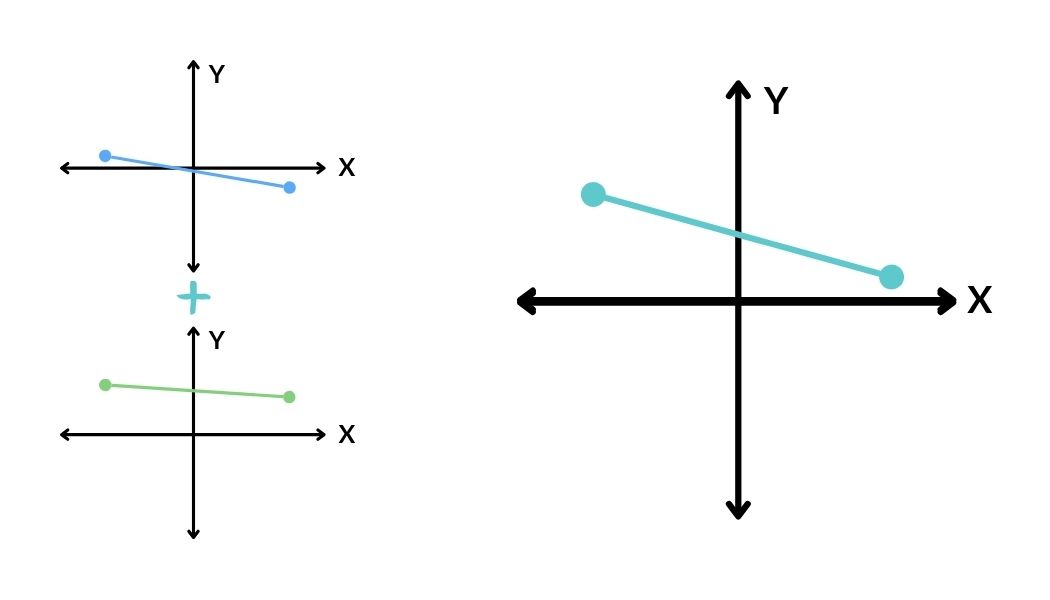
La suma de funciones se hace entrada a entrada en $\mathbb{R}^n$
Gráficamente muestra un desplazamiento punto a punto

Veremos la suma de transformaciones y la multiplicación por escalar.
Pero más que eso, veremos que dados dos espacios vectoriales, si para el conjunto de transformaciones lineales entre esos espacios, consideramos estas dos operaciones, formamos un nuevo espacio vectorial. Los dos grandes pilares del Álgebra Lineal por fin se unifican.

SUMA Y PRODUCTO DE TRANSFORMACIONES LINEALES

Definición: Sean $V,W$ $K$ – espacios vectoriales, $T,S\in\mathcal{L}(V,W)$ y $\lambda\in K$. Definimos las siguientes operaciones:

  • La suma de $T$ y $S$ es $T +_{\mathcal{L}} S: V \longrightarrow W$ donde $\forall v\in V ((T +_{\mathcal{L}} S)(v)=T(v) +_{\mathcal{W}} S(v))$.
  • El producto de $T$ por el escalar $\lambda$ es $\lambda \cdot_{\mathcal{L}} T: V \longrightarrow W$ donde $\forall v\in V ((\lambda \cdot_{\mathcal{L}} T)(v)=\lambda \cdot_{\mathcal{W}} T(v))$.

Ejemplos

  • Sean $K=\mathbb{R}$, $V=\{a+bx+cx^2+dx^3|a,b,c,d\in\mathbb{R}\}$ y $W=\mathbb{R}^3$.
    Sean $T:V\longrightarrow W$ dada por $T(a+bx+cx^2+dx^3)=(a-b+2c,b-d,2a+c)$ y $S:V\longrightarrow W$ dada por $S(a+bx+cx^2+dx^3)=(b,2c,3d)$. Entonces:
    $T+S:V\longrightarrow W$ es $(T+S)(a+bx+cx^2+dx^3)=(a+2c,b-d+2c,2a+c+3d)$
    $4\cdot S:V\longrightarrow W$ es $(4\cdot S)(a+bx+cx^2+dx^3)=(4b,8c,12d)$

Justificación. Sea $a+bx+cx^2+dx^3\in V$.

$(T+S)(a+bx+cx^2+dx^3)$$=T(a+bx+cx^2+dx^3)+S(a+bx+cx^2+dx^3)$$=(a-b+2c,b-d,2a+c)+(b,2c,3d)$$=(a-b+2c+b,b-d+2c,2a+c+3d)$$=(a+2c,b+2c-d,2a+c+3d)$

  • Sean $F$ un campo, $V=\mathcal{M}_{2\times 3}(F)$ y $W=\mathcal{M}_{2\times 2}(F)$.
    Sean $T:V\longrightarrow W$ dada por $T \begin{pmatrix} a_{11} & a_{12} & a_{13} \\ a_{21} & a_{22} & a_{23} \end{pmatrix} = \begin{pmatrix} 2a_{11} – 2a_{12} & a_{13} – 2a_{12} \\ 0 & 0 \end{pmatrix}$ y $S:V\longrightarrow W$ dada por $S \begin{pmatrix} b_{11} & b_{12} & b_{13} \\ b_{21} & b_{22} & b_{23} \end{pmatrix} = \begin{pmatrix} 0 & 0 \\ 2b_{21} – 2b_{22} & b_{23} – 2b_{22} \end{pmatrix}$. Entonces
    $T+2S:V\longrightarrow W$ es $(T+2S)\begin{pmatrix} a_{11} & a_{12} & a_{13} \\ a_{21} & a_{22} & a_{23} \end{pmatrix} = \begin{pmatrix} 2a_{11} – 2a_{12} & a_{13} – 2a_{12} \\ 4a_{21} – 4a_{22} & 2a_{23} – 4a_{22} \end{pmatrix}$

Justificación. $2S\begin{pmatrix} a_{11} & a_{12} & a_{13} \\ a_{21} & a_{22} & a_{23} \end{pmatrix}$$=2 \begin{pmatrix} 0 & 0 \\ 2a_{21} – 2a_{22} & a_{23} – 2a_{22} \end{pmatrix}$$= \begin{pmatrix} 0 & 0 \\ 4a_{21} – 4a_{22} & 2a_{23} – 4a_{22} \end{pmatrix}$

$(T+2S)\begin{pmatrix} a_{11} & a_{12} & a_{13} \\ a_{21} & a_{22} & a_{23} \end{pmatrix}$$= \begin{pmatrix} 2a_{11} – 2a_{12} & a_{13} – 2a_{12} \\ 0 & 0 \end{pmatrix} + \begin{pmatrix} 0 & 0 \\ 4a_{21} – 4a_{22} & 2a_{23} – 4a_{22} \end{pmatrix}$$= \begin{pmatrix} 2a_{11} – 2a_{12} & a_{13} – 2a_{12} \ 4a_{21} – 4a_{22} & 2a_{23} – 4a_{22} \end{pmatrix}$

Nota: Para las demostraciones de los siguientes teoremas, se considerará a $T_0 : V\longrightarrow W$ como la transformación donde $\forall v\in V(T_0(v)=\theta_W)$.

Proposición (2.5.1.): Sean $V,W$ $K$ – espacios vectoriales, $T,S\in\mathcal{L}(V,W)$ y $\lambda\in K$. Entonces $T+S\in\mathcal{L}(V,W)$ y $\lambda T\in\mathcal{L}(V,W)$.

Demostración: Sean $V,W$ $K$ – espacios vectoriales. Sean $T,S\in\mathcal{L}(V,W)$ y $\lambda\in K$.

P.D. 1) $T+S\in\mathcal{L}(V,W)$.

Sean $u,v\in V$ y $\lambda\in K$.
Entonces $(T+S)(\lambda u + v)=T(\lambda u + v)+S(\lambda u + v)$$=(\lambda T(u)+T(v))+(\lambda S(u)+S(v))$$=\lambda(T(u)+S(u))+(T(v)+S(v))=\lambda (T+S)(u)+(T+S)(v)$.
Como $(T+S)(\lambda u + v)=\lambda (T+S)(u)+(T+S)(v)$, entonces $T+S\in\mathcal{L}(V,W)$.

P.D. 2) $\lambda T\in\mathcal{L}(V,W)$.

Sean $u,v\in V$ y $\mu\in K$.

Entonces $(\lambda T)(\mu u + v)=\lambda T(\mu u + v)$$=\lambda (\mu T(u)+T(v))=\mu (\lambda T(u))+\lambda T(v)$$=\mu (\lambda T)(u)+(\lambda T)(v)$.
Como $(\lambda T)(\mu u + v)=\mu (\lambda T)(u)+(\lambda T)(v)$, entonces $\lambda T\in\mathcal{L}(V,W)$.

Teorema (2.5.2.): Sean $V,W$ $K$ – espacios vectoriales. Entonces $\mathcal{L}(V,W)$ con la suma y el producto escalar definidos es un $K$ – espacio vectorial.

Demostración: Sean $T,S,R\in\mathcal{L}(V,W)$ y $\lambda, \mu \in K$.

P.D. 1) $T+(S+R)=(T+S)+R$

Sea $v\in V$.
$(T+(S+R))(v)=T(v)+(S+R)(v)=T(V)+(S(v)+R(v))$$=(T(v)+S(v))+R(v)=(T+S)(v)+R(v)$$=((T+S)+R)(v)$.

Así, $\forall v\in V((T+(S+R))(v)=((T+S)+R)(v))$.
Por lo tanto, $T+(S+R)=(T+S)+R$.

P.D. 2) $T+S=S+T$

Sea $v\in V$.

$(T+S)(v)=T(v)+S(v)=S(v)+T(v)=(S+T)(v)$.

Así, $\forall v\in V((T+S)(v)=(S+T)(v))$.
Por lo tanto, $T+S=S+T$.

P.D. 3) $T+T_0=T_0+T=T$.

Sea $v\in V$.

$(T+T_0)(v)=T(v)+T_0(v)=T(v)+\theta_W=T(v)$.
$(T_0+T)(v)=(T+T_0)(v)=T(v)$.

Así, $\forall v\in V((T+T_0)(v)=(T_0+T)(v)=T(v))$.
Por lo tanto, $T+T_0=T_0+T=T$.
De este modo, $T_0$ cumple la función de neutro en $\mathcal{L}(V,W)$.

P.D. 4) Si $\tilde{T} : V\longrightarrow W$ donde $\forall v\in V(\tilde{T}(v)=-T(v))$, entonces $T+\tilde{T}=\tilde{T}+T=T_0$.

Sea $\tilde{T} : V\longrightarrow W$ donde $\forall v\in V(\tilde{T}(v)=-T(v))$.
Sea $v\in V$.

$(T+\tilde{T})(v)=T(v)+\tilde{T}(v)=T(v)+(-T(v))=\theta_W$.
$(\tilde{T}+T)(v)=(T+\tilde{T})(v)=\theta_W$.

Así, $\forall v\in V((T+\tilde{T})(v)=(\tilde{T}+T)(v)=\theta_W)$.
Por lo tanto, $T+\tilde{T}=\tilde{T}+T=T_0$.
De este modo, $\tilde{T}=-T=(-1)T\in\mathcal{L}(V,W)$ cumple la función de inverso de $T$ en $\mathcal{L}(V,W)$.

P.D. 5) $(1)T=T$.

Sea $v\in V$.

$(1T)(v)=(1)T(v)=T(v)$.

Así, $\forall v\in V((1T)(v)=T(v))$.
Por lo tanto, $(1)T=T$.

P.D. 6) $\lambda (\mu T)=(\lambda\mu)T$

Sea $v\in V$.

$(\lambda (\mu T))(v)=(\lambda )(\mu T)(V)$$=(\lambda )(\mu T(v))=(\lambda\mu )T(v)$$=((\lambda\mu )T)(v)$.

Así, $\forall v\in V((\lambda (\mu T))(v)=((\lambda\mu )T)(v))$.
Por lo tanto, $\lambda (\mu T)=(\lambda\mu )T$.

P.D. 7) $(\lambda + \mu)T=\lambda T + \mu T$.

Sea $v\in V$.

$((\lambda + \mu )T)(v)=(\lambda + \mu)T(v)=\lambda T(v)+\mu T(v)$$=(\lambda T)(v)+(\mu T)(v)=(\lambda T + \mu T)(v)$.

Así, $\forall v\in V((\lambda +\mu ) T)(v)=(\lambda T + \mu T)(v))$.
Por lo tanto, $(\lambda +\mu )T=\lambda T + \mu T$.

P.D. 8) $\lambda (T+S)=\lambda T + \lambda S$.

Sea $v\in V$.

$(\lambda (T+S))(v)=(\lambda )(T+S)(v)=\lambda (T(v)+S(v))$$=\lambda T(v)+ \lambda S(v)=(\lambda T)(v)+(\lambda S)(v)$$=(\lambda T + \lambda S)(v)$.

Así, $\forall v\in V((\lambda (T+S))(v)=(\lambda T + \lambda S)(v))$.
Por lo tanto, $\lambda (T+S)=\lambda T + \lambda S$.

Tarea Moral

  1. Sean $V$ y $W$ espacios vectoriales sobre el campo $K$ y $S\subseteq V$.
    Defina $S^0 = \{ T \in \mathcal{L}(V,W) | \forall x\in S(T(x) = \theta_W) \}$.
    ¿Es $S^0$ un subespacio de $\mathcal{L}(V,W)$ con las operaciones anteriormente vistas?
  2. Sea $W \leqslant V$ un $K$ – espacio vectorial.
    Definimos la clase lateral de $W$ que contiene a $v$ como $\forall v\in V ( { v } + W = { v+w|w \in W } )$ que para simplificar notación lo escribiremos como $v + W$
    Sea $W \leqslant V$ un $K$ – espacio vectorial.
    Definimos la clase lateral de $W$ que contiene a $v$ como $\forall v\in V ( { v } + W = { v+w|w \in W } )$ que para simplificar notación lo escribiremos como $v + W$
    a) Demuestra que $v + W$ es un subespacio de $V$ si y sólo si $v \in W$
    b) Demuestra que $v_1 + W = v_2 + W$ si y sólo si $v_1 – v_2 \in W$

Más adelante…

En la siguiente entrada veremos una nueva operación: la composición.
Y al igual que en las funciones reales, esta operación da lugar a un nuevo concepto: la identidad
¿Qué propiedades cumple la composición? ¿Cómo funciona en este caso la identidad?

Entradas relacionadas

33.1 Material de prueba: Un teorema fuerte de continuidad

Por Mariana Perez

Teorema:

Sea $f : \mathcal{K} \subset \mathbb{R}^n \longrightarrow \mathbb{R}^m.$

Si $f$ es continua en $\mathcal{K}$ y $\mathcal{K}$ es compacto, entonces $f$ es uniformemente continua en $\mathcal{K}.$

Demostración:

Sea $\epsilon > 0.$

Como $f$ es continua, para cada $x \in \mathcal{K}$ existe $\delta_x > 0$ tal que si $ \| x-y \| < \delta_x $ entonces $\big\|f(x) – f(y) \big\| < \frac{\epsilon}{2}$

Como $\mathcal{K}$ es compacto, $\mathcal{K} \subseteq \bigcup\limits_{x \in \mathcal{K}} B_{\frac{\delta_x}{2}}(x)$ es una cubierta abierta de $\mathcal{K}.$

Entonces, existe una subcubierta finita $B_{\frac{\delta_1}{2}}(x_1), \dots , B_{\frac{\delta_l}{2}}(x_l).$

Tomemos $ \delta = mín \big\{ \frac{\delta_1}{2} , \dots , \frac{\delta_l}{2} \big\}.$

Si $\big\| x \, – \, y \big\| < \delta $ entonces $ y \in B_{\delta}(x)$ pero $ x \in B_{\frac{\delta_j}{2}}(x_j) $ para alguna $j$

$$\big\| x \, – \, x_j \big\| < \frac{\delta_j}{2} \Rightarrow x_j \in B_{\frac{\delta_j}{2}}(x)$$

$$\big\| f(x) \, – \, f(x_j) \big\| < \frac{\epsilon}{2} $$

Luego, si $\big\| y \, – \, x_j \big\| = \big\| y \, – \, x \, + \, x \, – \, x_j \big\| \leq \big\| y \, – \, x \big\| + \big\|x \, – \, x_j \big\| < \delta + \frac{\delta_j}{2} \leq \frac{\delta_j}{2} + \frac{\delta_j}{2} = \delta $

$y \in B_{\delta_j}(x_j) \Rightarrow \big\| f(y) \, – \, f(x_j) \big\| < \frac{\epsilon}{2}$

En consecuencia,

$$\big\| f(x) \, – \, f(y) \big\| \leq \big\| f(x) \, – \, f(x_j) \big\| + \big\| f(x_j) \, – \, f(y) \big\| < \frac{\epsilon}{2} + \frac{\epsilon}{2} = \epsilon \; _{\blacksquare}$$

5.1 Material en revisión: ¿Por qué no hay norma – p para $p \in (0,1)$?

Por Mariana Perez

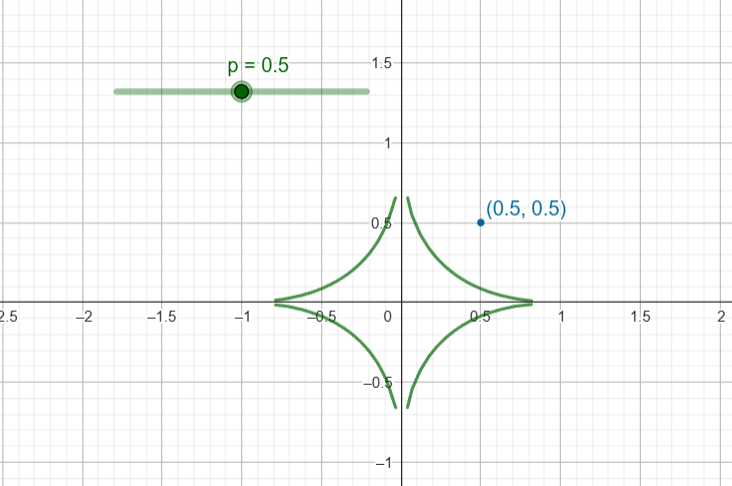
Observa que la bola unitaria no es convexa, es decir, que hay dos puntos en la bola $(1,0)$ y $(0,1)$ tales que el segmento $(1-t)(1,0) + t(0,1)$ no está contenido en la bola unitaria. En particular, para $t= \frac{1}{2}$

$$\frac{1}{2} (1,0) + \frac{1}{2} (0,1)=\Big(\frac{1}{2}, \frac{1}{2} \Big)$$

pero observa que el punto $\Big(\frac{1}{2}, \frac{1}{2}\Big)$ no está en la bola unitaria y debería estar,

ya que si $ \|(x,y)\|=(x^{\frac{1}{2}} + y^{\frac{1}{2}})^2$ fuera norma, entonces se debería cumplir que $$\Big\| \Big(\frac{1}{2}, \frac{1}{2} \Big) \Big\| = \Big\| \frac{1}{2} (1,0) + \frac{1}{2} (0,1) \Big\| \leq \frac{1}{2} \| (1,0) + (0,1) \| = 1 $$ pero eso no ocurre en este caso, ya que $ \Big( \big(\frac{1}{2} \big)^{\frac{1}{2}} + \big(\frac{1}{2} \big)^{\frac{1}{2}} \Big)^2 > 1$.

Por este motivo, no hay norma – p para cuando $p \in (0,1)$.

52.2 Material de prueba: Derivadas parciales continuas implican funciones continua

Por Mariana Perez

Teorema

Sea $f : \mathbb{R}^2 \rightarrow \mathbb{R}$, con $A$ abierto, tal que existen las derivadas parciales en $A$ y son acotadas, entonces $f$ es continua en $A$.

Demostración:

Sea $(x_0, y_0) \in A.$

$\Big[$ por demostrar : $f$ es continua en $(x_0, y_0) \Big]$

Basta demostrar que existe $L = \lim_{(x, y) \rightarrow (x_0, y_0)} f (x, y)$ y $ L = f (x_0, y_0).$

Sea $\epsilon > 0.$

Basta demostrar que existe $\delta > 0 $ tal que si

$\| (x, y) \, – \, (x_0, y_0) \| < \delta \Rightarrow |f (x, y) \, – \, f (x_0, y_0)|< \epsilon$

Como $\| (x, y) \, – \, (x_0, y_0) \| < \delta$

Sean $ h = x \, – \, x_0 $ y $ k = y \, – \, y_0 $ entonces, si $\| (h, k) \| < \delta \Rightarrow |f (x_0 + h, y_0 + k) \, – \, f (x_0, y_0) | < \epsilon$

$f (x_0 + h, y_0 + k) \, – \, f (x_0, y_0) = f (x_0 + h, y_0 + k) \, – \, f (x_0 , y_0 + k) \, + \, f (x_0, y_0 + k) \, – \, f (x_0, y_0) $

$f (x_0 + h, y_0 + k) \, – \, f (x_0, y_0) = \dfrac{\partial f}{\partial x} (x_0 + \theta_1 h, y_0 + k) h + \dfrac{\partial f}{\partial y} (x_0 , y_0 + \theta_2 k) k$ para algún $\theta_1, \theta_2 \in (0, 1)$

Sean $\xi = x_0 + \theta_1 h \; \in [x_0, x_0 + h]$

y $\eta = y_0 + \theta_2 k \; \in [y_0, y_0 + k]$

$\dfrac{\partial f}{\partial x}(\xi, y_0+k) = \dfrac{\Delta f}{h}$

$\dfrac{\partial f}{\partial y}(\xi, y_0+k)h = \Delta f$

Tomando el valor absoluto y aplicando la desigualdad del triángulo tenemos que:

$\Big| f (x_0 + h, y_0 + k) \, – \, f ( x_0, y_0) \Big| \leq \Bigg| \dfrac{\partial f}{\partial x}(x_0 + \theta_1h, y_0 + k) \Bigg| \Big|h \Big| + \Bigg| \dfrac{\partial f}{\partial y}(x_0 , y_0 + \theta_2k) \Bigg| \Big|k \Big| \leq M \Big| h \Big| + M \Big| k \Big| < \epsilon$

Para que $M \Big| h \Big| + M \Big| k \Big| < \epsilon$ se debe cumplir que

$$\big| h \big| \leq \sqrt{h^2 + k^2 } = \big\| (h, k) \big\|$$

$$\big| k \big| \leq \sqrt{h^2 + k^2 } = \big\| (h, k) \big\|$$

Luego $$\big| h \big| + \big| k \big| \leq 2 \sqrt{h^2 + k^2 } = 2 \big\| (h, k) \big\|$$

Entonces, para que se cumpla que $ 2M \big\| (h, k) \big\| < \epsilon$ basta pedir que

$$ \big\| (h, k) \big\| < \delta = \dfrac{\epsilon}{2M} \; _{\blacksquare}$$