Archivo del Autor: Mariana Perez

39. Material de prueba: Dos definiciones equivalentes de longitud de arco.

Por Mariana Perez

Teorema

Si $\alpha : [a, b] \subset \mathbb{R} \rightarrow \mathbb{R} $ es de clase $\mathcal{C}^1$, entonces la función que a cada $t \rightarrow \|{\alpha}’ (t)\|$ es continua, es de $ [a, b] \subset \mathbb{R} \rightarrow \mathbb{R}$ y podemos integrar, es decir, existe $$\int_{a}^{b} \|{\alpha}’ (t)\| dt$$

y $\mathcal{L} (\alpha) = \int_{a}^{b} \|{\alpha}’ (t)\| dt.$

Demostración:

$\mathcal{L} (\alpha) := \{ \mathcal{L} (C) \mid \mathcal{L} (C) = \sum\limits_{i = 1}^{n} \| \alpha (t_i) \, – \, \alpha(t_{i-1})\| \}$

En $\mathbb{R}^2$, $$\alpha (t) = ( x (t), y (t))$$

$$\alpha (t_i) = ( x (t_i), y (t_i))$$

$$\alpha (t_{i-1}) = ( x (t_{i-1}), y (t_{i-1}))$$

Luego $$\alpha (t_i) \, – \, \alpha (t_{i-1}) = ( x (t_i)\, – \, x (t_{i-1}), y (t_i) \, – \, y (t_{i-1}))$$

Entonces $$\Big\|\alpha (t_i) \, – \, \alpha (t_{i-1}) \Big\|= \sqrt {( x (t_i)\, – \, x (t_{i-1}))^2 + (y (t_i) \, – \, y (t_{i-1}))^2}$$

Entonces $$\sum\limits_{i = 1}^n \Big\|\alpha (t_i) \, – \, \alpha (t_{i-1}) \Big\|= \sum\limits_{i = 1}^n \sqrt {( x (t_i)\, – \, x (t_{i-1}))^2 + (y (t_i) \, – \, y (t_{i-1}))^2}$$

Existen $\xi_i \in (t_{i-1}, t_i)$ tales que $$\dfrac{x(t_i) \, – \, x(t_{i-1})}{t_i \, – \, t_{i-1}} = x’ (\xi) $$

Entonces $$x(t_i) \, – \, x(t_{i-1}) = x’ (\xi) (t_i \, – \, t_{i-1}) $$

De manera análoga, existen $\eta_i \in (t_{i-1}, t_i)$ tales que: $$y(t_i) \, – \, y(t_{i-1}) = y’ (\eta) (t_i \, – \, t_{i-1}) $$

Entonces $$\sum\limits_{i = 1}^n \Big\|\alpha (t_i) \, – \, \alpha (t_{i-1}) \Big\|= \sum\limits_{i = 1}^n \sqrt {( x’ (\xi_i))^2 (\Delta t_i)^2 + (y’ (\eta_i))^2 (\Delta t_i)^2}$$

con $\Delta t_i = t_i \, – \, t_{i-1}$ tenemos que el segundo miembro de la igualdad es:

$$\sum\limits_{i = 1}^n \sqrt {( x’ (\xi_i))^2 (\Delta t_i)^2 + (y’ (\eta_i))^2 (\Delta t_i)^2} = \sum\limits_{i = 1}^n \sqrt {( x’ (\xi_i))^2 + (y’ (\eta_i))^2 } (\Delta t_i)^2 $$

mientras que en el primer miembro obtenemos:

$$ \sum\limits_{i = 1}^n \Big\|\alpha (t_i) \, – \, \alpha (t_{i-1}) \Big\|= \int_a^b \Big\|{\alpha}’ (t) \Big\| dt $$

es el límite cuando la norma de la partición tiende a cero, de sumas de Riemann de la forma $$\sum\limits_{i = 1}^n \Big\|{\alpha}’ (\xi_i) \Big\| \Delta t_i$$

donde $\Big\|{\alpha}’ (\xi_i) \Big\| = \sqrt {( x’ (\xi_i))^2 + (y’ (\xi_i))^2 }$

Tenemos $\sum\limits_{i = 1}^n \sqrt {( x’ (\xi_i))^2 + (y’ (\eta_i))^2 } (\Delta t_i)$

Consideremos una función $F : [a, b] \times [a, b] \subset \mathbb{R}^2 \rightarrow \mathbb{R}$, donde $$F (s, t) = \sqrt {( x’ (s))^2 + (y’ (s))^2 }$$

Como $x’$ y $y’$ son continuas, tenemos que $F$ es continua en un conjunto compacto $ [a, b] \times [a, b] = K$ por lo que podemos concluir que $F$ es uniformemente continua.

Entonces, para todo $\epsilon > 0$ existe $\delta > 0$ tal que para toda pareja de puntos $p, q \in [a, b] \times [a, b] $

si $ \Big\| p – q \Big\| < \delta \Rightarrow \Big| F(p) – F(q) \Big| < \epsilon.$

Tomemos la norma de la partición $\mathcal{P}$ menor que $\delta$, es decir $t_i \, – \, t_{i-1} < \delta$

Como $\vec{p} = (\xi_i, \eta_i)$ y $\vec{q} = (\xi_i, \xi_i)$

Si $ \Big\| \vec{p} \, – \, \vec{q} \Big\| = \Big| \eta_i \, – \, \xi_i \Big| < \delta \Longrightarrow \Big| F(\vec{p}) \, – \, F(\vec{q}) \Big| < \epsilon$

Luego

$$ \Bigg| \sqrt {( x’ (\xi_i))^2 + (y’ (\eta_i))^2 } \, – \, \sqrt {( x’ (\xi_i))^2 + (y’ (\xi_i))^2 }\Bigg| < \epsilon$$

Multiplicando por $(t_i \, – \, t_{i-1})$

$$ \Bigg| \left(\sqrt {( x’ (\xi_i))^2 + (y’ (\eta_i))^2 } \, – \, \sqrt {( x’ (\xi_i))^2 + (y’ (\xi_i))^2 }\right) \Bigg|(t_i \, – \, t_{i-1}) < \epsilon (t_i \, – \, t_{i-1})$$

Sumamos

$$ \sum\limits_{i = 1}^n \Bigg| \left(\sqrt {( x’ (\xi_i))^2 + (y’ (\eta_i))^2 } \, – \, \sqrt {( x’ (\xi_i))^2 + (y’ (\xi_i))^2 }\right) \Bigg|(t_i \, – \, t_{i-1}) < \epsilon \sum\limits_{i = 1}^n (t_i \, – \, t_{i-1})$$

Entonces

$$\epsilon \sum\limits_{i = 1}^n (t_i \, – \, t_{i-1}) = \epsilon (b – a) $$

Por otro lado:

$$\Big| \mathcal{L}(C) \, – \, \mathcal{S}(f, \mathcal{P}) \Big| = \sum\limits_{i = 1}^n \Bigg| \left(\sqrt {( x’ (\xi_i))^2 + (y’ (\eta_i))^2 } \, – \, \sqrt {( x’ (\xi_i))^2 + (y’ (\xi_i))^2 }\right) \Bigg|(t_i \, – \, t_{i-1}) < \epsilon (b – a)$$

donde $f(t) = \sqrt {( x’ (t))^2 + (y’ (t))^2 }$

Luego $ \Big| \mathcal{L}(C) \, – \, \mathcal{S}(f, \mathcal{P}) \Big| < \epsilon (b – a)$

$\mathcal{L}(\alpha) = sup\{ \mathcal{L}(C)\}$ , donde $C$ es la trayectoria poligonal.

Entonces $\int_a^b \Big\|{\alpha}’ (t) \Big\| dt = \lim\limits_{\|\mathcal{P}\| \to 0} \mathcal{S} (f, \mathcal{P})$

Para todo $\epsilon > 0$ existe $c$ tal que $|\mathcal{L}(\alpha) \, – \, \mathcal{L}(C)| < \dfrac{\epsilon}{2}$

Para todo $\epsilon > 0$ existe $\mathcal{P}$ tal que

$ \Big| \mathcal{S}(f, \mathcal{P}) \, – \, \int_a^b \Big\|{\alpha}’ (t) \Big\| dt \Big| < \dfrac{\epsilon}{2}$

Existe una sucesión de curvas poligonales $\{ C_k\}_{k \in \mathbb{N}}$ tal que $\lim\limits_{k \to \infty} \mathcal{L}(C_k) = \mathcal{L}(\alpha)$

$ \lim\limits_{k \to \infty} \mathcal{S}(f , \mathcal{P}_k) = \int\limits_a^b \Big\|{\alpha}’ (t) \Big\| dt $ donde $\mathcal{P}_k$ son particiones de $[a, b].$

Afirmación:

$\Big| \mathcal{L}(C) \, – \, \mathcal{S}(f, \mathcal{P}_k) \Big| \rightarrow 0$ cuando $k \rightarrow \infty$

$$\therefore \mathcal{L}(\alpha) = \int\limits_a^b \Big\| {\alpha}'(t) \Big\| dt \; _{\blacksquare}$$

24. Material en revisión: De las coordenadas polares a las coordenadas rectangulares.

Por Mariana Perez

Dado un punto en coordenadas rectangulares $(x, y)$. ¿Cuáles son las coordenadas polares $( r, \theta)$? ¿Podemos despejar $(r, \theta)$ en función de $(x, y)$?

De $x^2 + y^2 = r ^2$, despejando $r$ se obtiene que $$r=\sqrt{x^2+y^2}$$

Para obtener el valor de $\theta$ tenemos dos maneras.

Una es usando la tangente $$\frac{y}{x} =\frac{r \sin \theta}{r \cos \theta} = \tan \theta$$ $$ \theta = \arctan \frac{y}{x}$$

Un detalle a tener en cuenta es que $x \neq 0$.

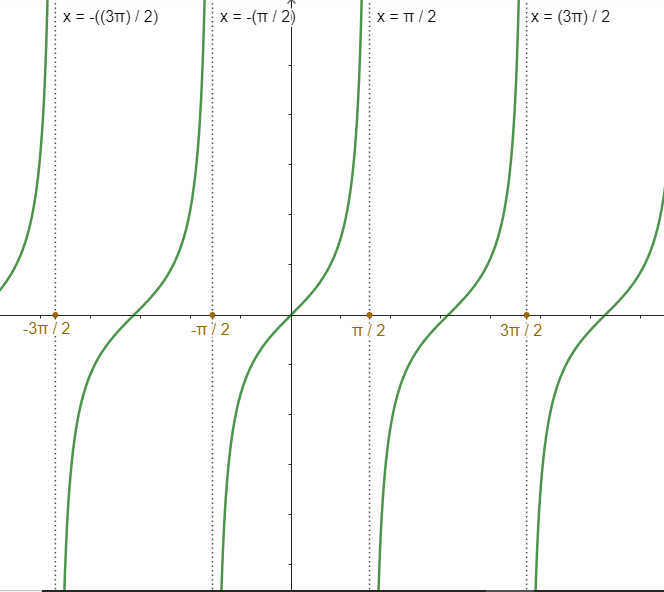
Además, podemos observar en la siguiente imagen que la función tangente $f(\theta) = \tan \theta$ tal que $f : \big(\frac{-\pi}{2}, \frac{\pi}{2}\big) \cup \big( \frac{\pi}{2}, \frac{3 \pi}{2}\big) \rightarrow \mathbb{R}$ no es inyectiva, y no tiene imagen inversa global, por lo que se debe elegir una rama, es decir un intervalo para el ángulo $\theta$.

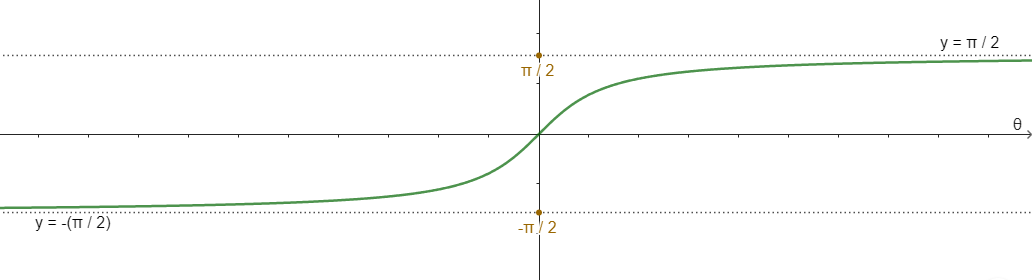
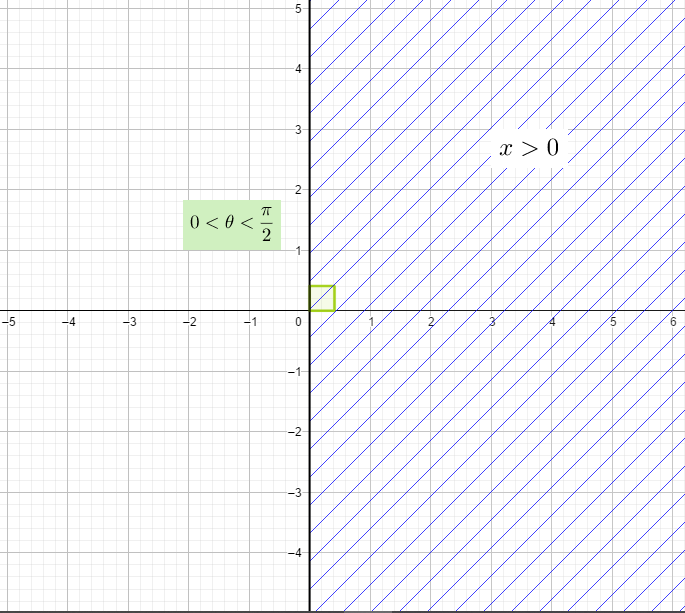
Si consideramos la rama $\frac{- \pi}{2}< \theta < \frac{\pi}{2}$, $f : \big(\frac{- \pi}{2}, \frac{ \pi}{2}\big) \rightarrow \mathbb{R}$ entonces la función $f(\theta) = \tan \theta$ si tiene función inversa $f^{-1} : \mathbb{R} \rightarrow \big(\frac{- \pi}{2}, \frac{ \pi}{2}\big)$ y por tanto la función $\arctan \big( \frac{y}{x} \big)$ toma valores en $\big(\frac{- \pi}{2}, \frac{ \pi}{2}\big)$.

Es decir cuando $x > 0$.

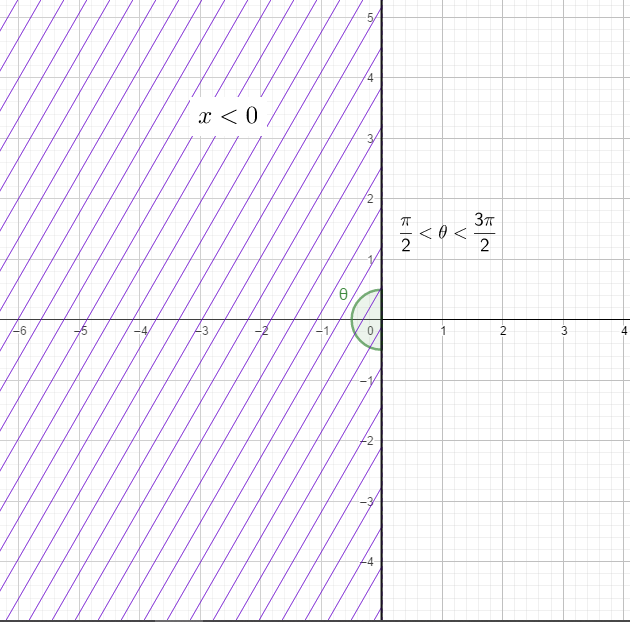
De manera análoga, si consideramos la rama $\frac{\pi}{2}< \theta < \frac{3 \pi}{2}$, $f : \big(\frac{3 \pi}{2}, \frac{ \pi}{2}\big) \rightarrow \mathbb{R}$ entonces la función $f(\theta) = \tan \theta$ si tiene función inversa $f^{-1} : \mathbb{R} \rightarrow \big(\frac{3 \pi}{2}, \frac{ \pi}{2}\big)$ y por tanto la función $\arctan \big( \frac{y}{x} \big)$ toma valores en $\big(\frac{3 \pi}{2}, \frac{ \pi}{2}\big)$.

Es decir para cuando $x < 0$.

Otra manera es la siguiente.

Despejando $(r, \theta)$ en términos de $(x, y)$ de la ecuación $$x^2 + y^2 = r ^2$$

Obtenemos que $$r= \sqrt{x^2+y^2}$$

Sustituyendo el valor de $r$ obtenido, en la ecuación $\cos{\theta} = \frac{y}{x}$ obtenemos que $\cos{\theta} = \frac{x}{\sqrt{x^2+y^2}}$ por lo que el valor de $\theta$ está dado por $$\theta = \arccos\left( \frac{x}{\sqrt{x^2+y^2}}\right)$$

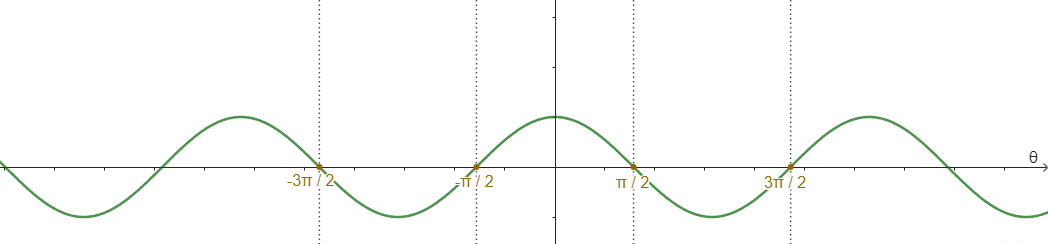
La función coseno tampoco es inyectiva sobre $\mathbb{R}$. Para poder hablar de la inversa hay que restringir el intervalo donde varia $\theta$.

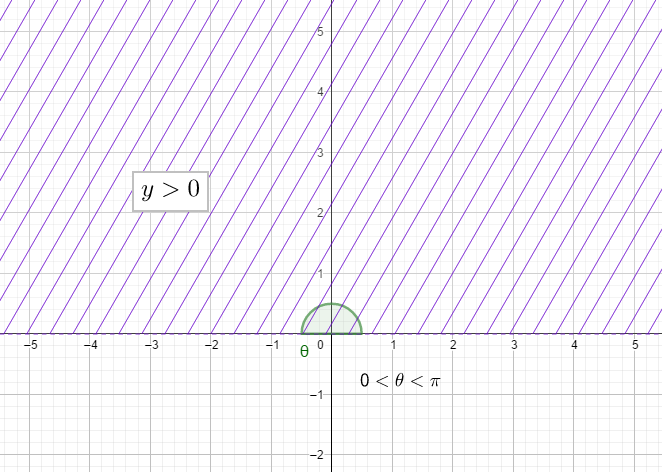
Una opción es $0 < \theta < \pi$.

Es decir, se debe escoger el intervalo de $\theta$ que mejor nos permita calcular el ángulo dependiendo de donde se encuentre el punto $(x, y)$.

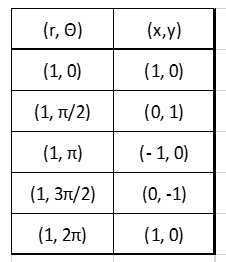
$$T : \mathbb{R}^2 \longrightarrow \mathbb{R}^2$$ $$(r, \theta) \longrightarrow (x, y)$$

Mediante tabulación.

Si fijamos $r_0 = 1$ y variamos $\theta$, tenemos que $x = r_0 \cos \theta$ entonces $x = \cos \theta$ y para $y = r_0 \sin \theta$ se obtiene $y = \sin \theta$. Luego $(x, y) = ( \cos \theta, \sin \theta)$.

Analíticamente para $r_0 = 1$ $$x^2+y^2=\cos^2 \theta + \sin^2 \theta$$ $$x^2+y^2=1$$

Por lo que la recta $r = 1$ en coordenadas polares es la circunferencia unitaria en coordenadas cartesianas.

Si fijamos $r_0 = 2$ y variamos $\theta$ se obtiene $$x^2+y^2=(2 \cos \theta)^2 + (2 \sin \theta)^2 = 4 \cos^2 \theta + 4 \sin^2 \theta = 4 (\cos^2 \theta + \sin^2 \theta) = 4$$

$$x^2+y^2=4$$

Por lo que la recta $r = 2$ en coordenadas polares es la circunferencia de radio 2 en coordenadas cartesianas.

Además, la recta $r = 0$ en coordenadas polares, es el punto $(0, 0)$ en coordenadas cartesianas.

https://www.geogebra.org/classic/rhv8nvwx

Ahora consideremos una recta horizontal $\theta = \theta_0$

$x = r \cos \theta_0$

$y = r \sin \theta_0$

$(x, y) = (r \cos \theta_0, r \sin \theta_0)$

$(x, y ) = r ( \cos \theta_0, \sin \theta_0)$

El factor $ (\cos \theta_0, \sin \theta_0)$ es constante, si variamos $r$ tenemos que:

* Si $r > 0$ la recta horizontal en coordenadas polares es un rayo que parte del origen en coordenadas cartesianas; pero si $r \in \mathbb{R} $ se transforma en la recta generada por el vector unitario $\vec{u} = (\cos \theta_0, \sin \theta_0)$.

En la siguiente animación dejamos fijo el ángulo y variamos el valor de $r$.

https://www.geogebra.org/c

En la siguiente animación puedes variar al mismo tiempo $r, \Delta r, \theta$ y $\Delta \theta$ y observar las transformación en la segunda ventana.

https://www.geogebra.org/classic/kwbmfxfn

48.Material de prueba: Representar paramétricamente una curva algebraica

Por Mariana Perez

Definición: Una curva algebraica es un conjunto de puntos del plano tales que $$\{ (x, y) \in \mathbb{R}^2 \mid F (x, y) = 0 \} = F^{-1} (0)$$

Por ejemplo:

$F (x, y)$ un polinomio en dos variables.

$F (x, y) = x^2 + y^2 \, – \, 1$

$F^{-1} (0) = 0$

${}$

Sea $x = \cos \theta$, $y = \sin \theta$.

El punto $P(\cos \theta, \sin \theta)$ recorre la curva de nivel.

Representar paramétricamente con funciones racionales

$$ x = \phi (t) = \dfrac{p (t)}{q (t)}$$

$$ y = \psi (t) = \dfrac{\hat{p} (t)}{\hat{q} (t)}$$

$\begin{align*} x &= \dfrac{ t^2 \, – \, 1}{t^2 \, + \, 1} & x^2 &= \dfrac{ (t^2 \, – \, 1)^2}{(t^2 \, + \, 1)^2}\\ y &= \dfrac{ 2t}{t^2 \, + \, 1} & y^2 &= \dfrac{ (4t^2}{(t^2 \, + \, 1)^2}\end{align*}$

Luego $x^2 \, + \, y^2 = \dfrac{ t^4 \, – \, 2t^2 \, + \, 1 \, + \, 4t^2 \,}{(t^2 \, + \, 1)^2} = \dfrac{ t^4 \, + \, 2t^2 \, + \, 1 \,}{(t^2 \, + \, 1)^2} = \dfrac{(t^2 \, + \, 1)^2}{(t^2 \, + \, 1)^2} = 1$

¿Cuándo lo podemos usar?

$\int \sqrt{p (x) \, } \dfrac{dx}{dt}dt = \int \sqrt{p (x) \, } dx$

$y^2 = p (x)$

$x = \phi (t) $

$y = \psi (t) $

$\int \psi (t) {\phi}’ (t) dt $

${}$

${}$

Un caso particular $$F (x, y) = G (x, y) + J (x, y) = 0$$

Con $G$ homogénea (todos los términos del mismo grado) de grado $n \, – \, 1$ y $J$ homogénea de grado $n.$

$G (x, tx) \, + \, J (x, tx) = 0$

$x^{n-1} G (1, t) \, + \, x^n J (1, t) = 0$

Si $x \neq 0$ divido entre $x^{n-1}$ entonces,

$ G (1, t) \, + \, x J (1, t) = 0$

Entonces $ x = \dfrac{ – \, G (1, t) }{ J (1, t) }$

como $y = tx$ entonces $ y = \dfrac{ – \, t G (1, t) }{ J (1, t) }$

${}$

Ejemplo

$$F (x, y) = x^3 + y^3 \, – \, 3xy$$

$$F (x, y) = 0$$

Observamos que $F (0, 0) = 0$ por lo tanto, $(0, 0) \in F^{-1} (0).$

$y = tx$

$F (x, tx) = x^3 + t^3 x^3 \, – \, 3x^2 t = 0 $

Si $x \neq 0$ entonces dividimos entre $x^2$ y obtenemos que

$F (x, tx) = x + t^3 x \, – \, 3 t = 0 $

$ F (x, tx) = x ( 1 + t^3 ) = 3 t $

Luego $x = \dfrac{3 t}{( 1 + t^3 )}$

Y por tanto $ y = x t \Rightarrow y = \dfrac{3 t^2 }{( 1 + t^3 )}$

De modo que $$\alpha (t) = \Bigg( \dfrac{3 t}{( 1 + t^3 )}, \dfrac{3 t^2 }{( 1 + t^3 )}\Bigg)$$

Observaciones:

(*) Si $ t \rightarrow – \, 1 $ entonces $ t^3 \rightarrow – \, 1 $ y $ 1 + t^3 \rightarrow 0. $

Por lo que $x (t) = \dfrac{3 t}{( 1 + t^3 )} \rightarrow \infty$

y $\; \; \; y (t) = \dfrac{3 t^2}{( 1 + t^3 )} \rightarrow \infty$

Entonces $\dfrac{ y (t)}{ x (t) } \dfrac{tx}{x} = t \rightarrow \, – \, 1$

Intersección de la curva $F (x, y) = 0$ con las rectas $y = t x$ son los puntos $\alpha (t).$

(*) Si $ t \rightarrow 0 $ para $t > 0$ , enotnces $\alpha (t) \rightarrow (0, 0) $

Análogamente si $ t \rightarrow 0 $ para $t > 0$

(*) Si $ t \rightarrow \infty $ para $t > 0$ entonces $\alpha (t) \rightarrow (0, 0) $. Análogamente $ t \rightarrow \, – \, \infty $

${}$

Ahora calculamos el punto donde la tangente es paralela al eje $x$, es decir, el punto máximo del bucle.

Para esto máximizamos $y (t) = \dfrac{3 t^2 }{( 1 + t^3 )}$

Derivando $y’ (t) = \dfrac{( 1 + t^3 ) (6 t) \, – \, (3 t^2) (3 t^2) }{( 1 + t^3 )^2}$

Entonces $y’ (t) = \dfrac{6t + 6 t^4 \, – \, 9 t^4 }{( 1 + t^3 )^2} $

Cuando $y’ (t) = \dfrac{6t \, – \, 5 t^4 }{( 1 + t^3 )^2} = 0 $

$$\dfrac{6t \, – \, 5 t^4 }{( 1 + t^3 )^2} = 0 \iff 6t \, – \, 5 t^4 = 0 \iff 6t = 5 t^4 \iff t^3 = \dfrac{6}{5} \iff \textcolor{Green}{t = \sqrt[3]{\dfrac{6}{5}\, }}$$

Por último, calculamos el radio del bucle.

$r^2 = x^2 + y^2 = \Bigg(\dfrac{3 t}{( 1 + t^3 )}\Bigg)^2 + \Bigg(\dfrac{3 t^2 }{( 1 + t^3)}\Bigg)^2 = \dfrac{ 9 t^2 ( 1 + t^2)}{( 1 + t^3 )^2}$

Por lo tanto $$\textcolor{Red}{r = \dfrac{ 3 t \sqrt{ 1 + t^2 \, }}{ 1 + t^3 }}$$

En este enlace puedes observar una animación del ejemplo estudiado.

https://www.geogebra.org/classic/pcuuydev

47. Material de prueba: Lemniscata de Bernoulli

Por Mariana Perez

La Lemniscata puede definirse como el lugar geométrico de los puntos $P$ tales que el producto de sus distancias a dos puntos dados $F_1$ y $F_2$ es constante.

$$d(P, F_1) d(P, F_2) = k$$

Ejemplo:

Sean $ F_1 = \Big(\dfrac{1}{2}, \dfrac{1}{2}\Big) \; $ ; $\; F_2 =\Big(\dfrac{-1}{2}, \dfrac{-1}{2}\Big) \; $

y $\; k = \dfrac{1}{2}$

Sea $P (x, y)$, entonces

$d(P, F_1) = \sqrt{\Big( x \, – \, \dfrac{1}{2}\Big)^2 + \Big( y \, – \, \dfrac{1}{2}\Big)^2 \; }$

$d(P, F_2) = \sqrt{\Big( x \, + \, \dfrac{1}{2}\Big)^2 + \Big( y \, + \, \dfrac{1}{2}\Big)^2 \; }$

$\sqrt{\Big( x \, – \, \dfrac{1}{2}\Big)^2 + \Big( y \, – \, \dfrac{1}{2}\Big)^2 \; } \sqrt{\Big( x \, + \, \dfrac{1}{2}\Big)^2 + \Big( y \, + \, \dfrac{1}{2}\Big)^2 \; } = \dfrac{1}{2}$

$\Bigg( \Big( x \, – \, \dfrac{1}{2}\Big)^2 + \Big( y \, – \, \dfrac{1}{2}\Big)^2 \Bigg) \Bigg( \Big( x \, + \, \dfrac{1}{2}\Big)^2 + \Big( y \, + \, \dfrac{1}{2}\Big)^2 \Bigg) = \Bigg(\dfrac{1}{2}\Bigg)^2$

$$\Bigg( x^2 \, – \, x \, + \, \dfrac{1}{4} + y^2 \, – \, y \, + \, \dfrac{1}{4} \Bigg) \Bigg( x^2 \, + \, x \, + \, \dfrac{1}{4} + y^2 \, + \, y \, + \, \dfrac{1}{4}\Bigg) = \dfrac{1}{4}$$

$$ \textcolor{DarkBlue}{x^4} \, + \, \cancel{x^3} \, + \, \cancel{\dfrac{1}{4}x^2} + \textcolor{DarkBlue}{x^2 y^2} \, + \, \cancel{x^2 y} \, + \, \cancel{\dfrac{1}{4} x^2} \, – \, \cancel{x^3} \, – \, \cancel{x^2} \, – \, \cancel{\dfrac{1}{4} x}$$

$$ \cancel{- x y^2} \, \textcolor{DarkBlue}{- \, xy} \, – \, \cancel{\dfrac{1}{4}x} \, + \, \cancel{\dfrac{1}{4}x^2} \, + \, \cancel{\dfrac{1}{4} x} \, + \, \cancel{\dfrac{1}{16}} + \cancel{\dfrac{1}{4}y^2} \, + \, \cancel{\dfrac{1}{4}y} \, + \, \cancel{\dfrac{1}{16}} \, $$

$$+ \, \textcolor{DarkBlue}{x^2y^2} \, + \, \cancel{ xy^2} \, + \, \cancel{\dfrac{1}{4} y^2} + \textcolor{DarkBlue}{y^4} \, + \, \cancel{y^3} \, + \, \cancel{\dfrac{1}{4} y^2} \, – \, \cancel{x^2y} \, \textcolor{DarkBlue}{- \, xy} \, – \, \cancel{\dfrac{1}{4}y} – \cancel{y^3} \, – \, \cancel{y^2} \, – \, \cancel{\dfrac{1}{4}y} \,$$

$$ + \, \cancel{\dfrac{1}{4}x^2} \, + \, \cancel{\dfrac{1}{4}x} \, + \, \cancel{\dfrac{1}{16}} + \cancel{\dfrac{1}{4} y^2} \, + \, \cancel{\dfrac{1}{4} y} \, + \, \cancel{\dfrac{1}{16}} = \cancel{\dfrac{1}{4}}$$

${}$

$$ \textcolor{DarkBlue}{x^4} \, + \, 2 \textcolor{DarkBlue}{x^2 y^2} \, + \, \textcolor{DarkBlue}{y^4} \textcolor{DarkBlue}{- \, 2 xy}= 0 $$

Por lo tanto

$$ \textcolor{DarkBlue}{\Big(x^2 \, + \, y^2\Big)^2 \, = \, 2 xy} $$

${}$

En coordenadas polares:

$ x = r \cos \theta$

$ y = r \sin \theta$

$ x^2 + y^2 = r^2$

Luego

$r^4 = 2 r \cos \theta r \sin \theta$

$r^4 = 2 r^2 \cos \theta \sin \theta$

$ r^2 = 2 \cos \theta \sin \theta$

Por lo tanto, $ r^2 = \sin (2 \theta)$

Observaciones:

$r^2 \geq 0$ por lo que $sin (2 \theta) \geq 0$

Luego $ \sin (2 \theta) \geq 0 \iff \theta \in \Bigg[ 0, \dfrac{\pi}{2}\Bigg] \bigcup \Bigg[ \pi , \dfrac{3\pi}{2} \Bigg]$

Si $\theta \in \Bigg[ 0, \dfrac{\pi}{4} \Bigg] \Rightarrow 0 \leq 2 \theta \leq \dfrac{\pi}{2}$

Entonces $sin 0 \leq sin (2 \theta) \leq \sin \dfrac{\pi}{2}$ por lo que

$ 0 \leq \sin (2 \theta) \leq 1$ entonces $0 \leq r^2 \leq 1$ y por tanto $0 \leq r \leq 1.$

Análogamente, si $\theta \in \Bigg[ \dfrac{\pi}{2}, \dfrac{3 \pi}{4}\Bigg] \Rightarrow \pi \leq 2 \theta \leq \dfrac{3 \pi}{2}$

En el siguiente enlace puedes observar una animación de la Lemniscata.

https://www.geogebra.org/classic/xef6rmxd

${}$

Se puede calcular el área de cada pétalo de la Lemniscata.

$x (t) = \sqrt{ \sin (2 t) \, } \cos t$

$y (t) = \sqrt{ \cos (2 t) \, } \sin t$

Entonces $$F (x, y) = \big( x^2 + y^2 \big)^2 \, – \, 2xy = 0 $$

Podemos ver la Lemniscata como una curva de nivel $F : \mathbb{R}^3 \rightarrow \mathbb{R}$

¿Cómo será el valor de $F( x, y)$ cuando el punto $( x, y)$ está fuera de la Lemniscata?

¿Cómo será cuando el punto esté adentro?

Tomemos $P \Big(0, 1\Big)$ un punto fuera de la Lemniscata.

Entonces $F \Big(0, 1\Big) = (0)^2 + (1)^2 \, – \, 2 (0) (1) = 1 $. $F$ es positiva.

${}$

Tomemos $P \Big( \dfrac{1}{2}, \dfrac{1}{2} \Big)$ un punto dentro de la Lemniscata.

Entonces $F \Big(\dfrac{1}{2}, \dfrac{1}{2}\Big) = \Bigg( \Big( \dfrac{1}{2}\Big)^2 + \Big( \dfrac{1}{2}\Big)^2 \Bigg)^2 \, – \, 2 \Big(\dfrac{1}{2}\Big) \Big(\dfrac{1}{2} \Big) = \Bigg( \dfrac{1}{4} + \dfrac{1}{4} \Bigg)^2 \, – \, \dfrac{1}{2} = \dfrac{1}{4} \, – \, \dfrac{1}{2} = \dfrac{-1}{2}$. Entonces $F$ es negativa.

Analicemos algunos cortes verticales

$x = 0$

$F (0, y) = \big( 0^2 + y^2 \big)^2 \, – \, 2 (0) y = y^4 $

$x =1$

$F (1, y) = \big( 1^2 + y^2 \big)^2 \, – \, 2 (1) y = \big( 1^2 + y^2 \big)^2 \, – \, 2 y $

$x = 2$

$F (2, y) = \big( 2^2 + y^2 \big)^2 \, – \, 2 (2) y = \big( 4 + y^2 \big)^2 \, – \, 4 y $

46. Material de prueba: Curvatura de una curva dada por la gráfica de una función.

Por Mariana Perez

Si una curva está dada por la gráfica de una función $\mathbb{R} \rightarrow \mathbb{R}$

$$\Gamma := \big\{ (x, y) \in \mathbb{R}^2 \big| y = f (x) \big\}$$

Donde, $\alpha (t) = (t, f (t)) $, y

${\alpha}’ (t) = ( 1, f’ (t) ).$

Además, $\big\|{\alpha}’ (t) \big\| = \sqrt{ 1 + (f’ (t_0) )^2}$

Observación: Con esta parametrización la rapidez $\big\|{\alpha}’ (t) \big\| \geq 1$ solo puede ser $\big\|{\alpha}’ (t) \big\| \equiv 1$ en el caso $f’ (t) \equiv 0.$

Fórmula para la curvatura

$$ \mathcal{K} = \dfrac{\begin{vmatrix} x’ & {x}^{\prime \prime} \\ y’ & {y}^{\prime \prime} \end{vmatrix}}{\big\|{\alpha}’ (t) \big\|^3}$$

Como $\begin{align*} x (t) &= t & x’ (t) &= 1 & {x}^{\prime \prime} (t) &= 0\\ y (t) &= f (t) & y’ (t) &= f’ (t) & {y}^{\prime \prime} (t) &= {f}^{\prime \prime} (t) \end{align*}$

Entonces

$$ \mathcal{K} = \dfrac{\begin{vmatrix} 1 & 0 \\ f’ (t) & { f}^{\prime \prime} (t) \end{vmatrix}}{\sqrt{\big(1 + (f’ (t))^2 \big)}^3}$$

Luego

$$ \mathcal{K} = \dfrac{ { f}^{\prime \prime} (t) }{\sqrt{\Big(1 + (f’ (t))^2 \Big)}^3}$$

para una curva dada como la gráfica de una función.

En el siguiente enlace puedes ver una animación de una parábola y su curvatura.

https://www.geogebra.org/classic/j8qsv2kb

${}$

Una forma para calcular el área encerrada por una curva simple, cerrada, parametrizada y plana.

Vamos a tratar de calcular el área usando sumas de Riemann de la forma $$\sum f (\xi_i) \Delta t_i$$

Para el «rectángulo» pequeño tenemos que

Base $\Delta x_i = x (t_i) \, – \, x (t_{i-1})$

Altura $y (\xi_i)$

Entonces, el área es

$A_1 = y (\xi_i) \big( x (t_i) \, – \, x (t_{i-1})\big)$

Para el «rectángulo» grande tenemos que

Base $\Delta x_j =\, – \, \big( x (t_j) \, – \, x (t_{j-1}) \big)$

Altura $y (\xi_j)$

Entonces, el área es

$A_2 = y (\xi_j) \Big( \, – \, \big( x (t_j) \, – \, x (t_{j-1})\big) \Big)$

Luego el área total es

$$ A = \, – \, \Big( y (\xi_j) \Delta x_j + y (\xi_i) \Delta x_i \Big)$$

$$ A = \, – \, \sum y (\xi_i) (\Delta x_i) = \, – \, \sum y (\xi_i) \dfrac{dx}{dt} (\Delta t)$$

Por lo tanto $$ A = \, – \, \int_a^b y (t) \dfrac{dx}{dt} dt$$

donde

$\Delta x_i = x (t_i) \, – \, x (t_{i-1})$

$\dfrac{\Delta x_i }{\Delta t_i} = \dfrac{x (t_i) \, – \, x (t_{i-1})}{t_i \, – \, t_{i-1}}$

$\Delta x_i = \dfrac{\Delta x_i}{\Delta t_i} dt_i$

Luego $$A = \dfrac{1}{2} \int_a^b \Bigg( x \dfrac{dy}{dt} \, – \, y \dfrac{dx}{dt} \Bigg)dt$$

$$ A = \dfrac{1}{2} \begin{vmatrix} x & \dfrac{dx}{dt}\\ y & \dfrac{dy}{dt} \end{vmatrix}$$