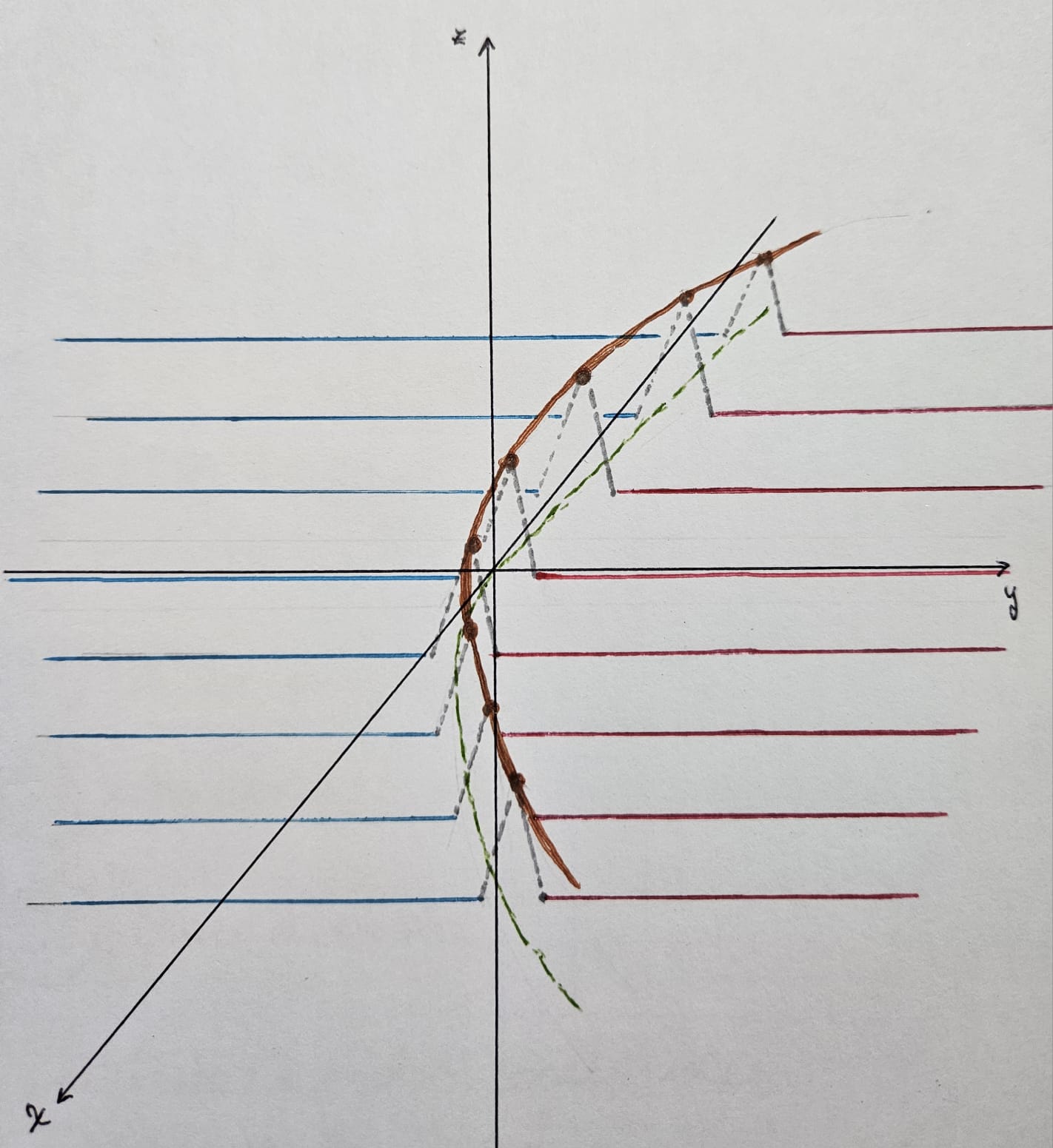
Archivo del Autor: Mariana Perez

51. Material de prueba: Derivadas de funciones de $\mathbb{R}^n \rightarrow \mathbb{R}$

Por Mariana Perez

Derivada parcial

Sea $f : A \subseteq \mathbb{R}^n \rightarrow \mathbb{R}$.

Sea $(x_0, y_0) \in A$, con $A$ abierto.

Las derivadas parciales de $f$ con respecto a $x$ (con respecto a $y$) en el punto $(x_0, y_0)$ se define como: $$\dfrac{\partial f}{\partial x}(x_0, y_0) := \lim_{h \rightarrow 0} \dfrac{f (x_0 + h, y_0) \, – \, f (x_0, y_0) }{h}$$ $$\dfrac{\partial f}{\partial y}(x_0, y_0) := \lim_{k \rightarrow 0} \dfrac{f (x_0 , y_0 + k) \, – \, f (x_0, y_0) }{h}$$

Notación:

También se suele escribir $\dfrac{\partial f}{\partial x}(x_0, y_0)$ como $f_x (x_0, y_0)$, y $\dfrac{\partial f}{\partial y}(x_0, y_0)$ como $f_y (x_0, y_0)$.

Algebraicamente, fijamos una variable y derivamos respecto de la otra.

Geométricamente, la derivada parcial de $f$ con respecta a $x$ es la pendiente de la recta tangente a la curva $x \rightarrow f(x, y_0)$ que se obtiene al hacer un corte con el plano $y = y_0.$

La existencia de las derivadas parciales es necesaria para que exista el plano tangente a la superficie $z = f (x,y)$ en el punto $(x_0, y_0)$. En tal caso, la ecuación del plano tangente sería $$z = f (x_0, y_0) + \frac{\partial f}{ \partial x} (x_0, y_0) (x – x_0) + \frac{\partial f}{ \partial y} (x_0, y_0) (y – y_0) $$ Sin embargo, podría ser que la función no sea diferenciable en el punto $(x_0, y_0)$ aunque existan las derivadas parciales. En tal caso, la ecuación anterior es la de un plano pero no existe plano tangente.

Ejemplo:

$f (x, y) = x^{\frac{1}{3}} y^{\frac{1}{3}}$

Calculemos la $\dfrac{\partial f}{\partial x} (0, 0)$

$$\dfrac{\partial f}{\partial x} (0, 0) = \lim_{h \rightarrow 0} \dfrac{f (h, 0) \, – \, f (0, 0) }{ h} = \lim_{h \rightarrow 0} \dfrac{0}{h} = \lim_{h \rightarrow 0} 0 = 0$$

Corte con el plano $y_0 = 0$ (el plano $XZ$) es $z = f (x, 0) = x^{\frac{1}{3}} 0^{\frac{1}{3}} = 0$

Análogamente, $$\dfrac{\partial f}{\partial y} (0, 0) = 0$$

Corte con el plano $x_0 = 0$ (el plano $YZ$) es $z = f (0, y) = 0^{\frac{1}{3}} y^{\frac{1}{3}} = 0$

Si hubiera plano tangente debería ser el plano $z = 0$, es decir, el plano $XY$.

Sin embargo, esta función no es diferenciable. A continuación, discutiremos el concepto de función diferenciable.

En el siguiente enlace puedes observar la curva definida por $f (x, y) = x^{\frac{1}{3}} y^{\frac{1}{3}}$ y los cortes que se estuvieron analizando.

https://www.geogebra.org/classic/eqgy88vq

${}$

A continuación, se motivará la definición de función diferenciable.

El gradiente de una función $f : \mathbb{R}^2 \rightarrow \mathbb{R}$ en un punto $(x_0, y_0)$ es el vector $\Big( \dfrac{\partial f}{\partial x} (x_0, y_0), \dfrac{\partial f}{\partial y} (x_0, y_0) \Big)$

Notación: $ \nabla f (x_0, y_0)$.

${}$

Recordemos, ¿qué sucede con funciones de $\mathbb{R} \rightarrow \mathbb{R}$?

$f’ (x_0)$ es la pendiente de la recta tangente en el punto $(x_0, y_0)$.

La ecuación de la recta tangente a la curva $y = f (x)$ en el punto $(x_0, f(x_0))$ es $$y \, – \, f(x_0) = f’ (x_0) (x \, – \, x_0)$$

Aproximación de $f$ con una función lineal $y = f(x_0) + f’ (x_0) (x \, – \, x_0)$.

Es decir, $\lim_{h \rightarrow 0} \dfrac{f (x_0 + h) \, – \, f (x_0) \, – \, f’ (x_0)h}{h} = 0$, donde $h = x \, – \, x_0$.

${}$

Para funciones de $\mathbb{R}^2 \rightarrow \mathbb{R} $,¿qué representa el $\nabla f (x_0, y_0) = \Big( \dfrac{\partial f}{\partial x} (x_0, y_0), \dfrac{\partial f}{\partial y} (x_0, y_0) \Big)$?

Ecuación del plano tangente a la superficie $z = f (x, y)$ en el punto $\big( x_0, y_0, f(x_0, y_0) \big)$

Consideremos la función lineal de $\mathbb{R}^2 \rightarrow \mathbb{R}$ $$f (x, y) = ax + by$$ con $a, b \in \mathbb{R}$ constantes.

Corte con el plano $y_0 = 0$ (plano $XZ$).

$z = f (x, 0) = ax$ entonces $a$ es la pendiente de la recta $z = ax$ en el plano $XZ$.

Corte con el plano $x_0 = 0$ (plano $YZ$).

$z = f (0, y) = by$ entonces $b$ es la pendiente de la recta $z = by$ en el plano $YZ$.

$f (x, y) = ax + by$

$\dfrac{\partial f}{\partial x} = a $

$\dfrac{\partial f}{\partial y} = b $

Entonces $\nabla f = (a, b)$

Si un plano tiene la ecuación $ax + by + z = 0$ entonces, $(a, b, c) \cdot (x, y, z) = 0$.

El vector $(a, b, c)$ es el vector normal al plano $$\vec{n} = (a, b, c)$$ $$\vec{x} = (x, y, z)$$

Luego $\vec{n} \cdot \vec{x} = 0$ por lo que el vector $\vec{x}$ es perpendicualr al vector $\vec{n}$.

Si un plano pasa por el punto $(x_0, y_0)$ y tiene el vector normal $(a, b, c)$.

Que $\Big( (x, y, z)\, – \, (x_0, y_0, z_0) \Big) \cdot (a, b, c) = 0$, entonces

$$a (x \, – \, x_0) + b (y \, – \, y_0) + c (z \, – \, z_0) = 0$$

entonces $ ax + by + cz = d$ es la ecuación de un plano que no pasa por el punto $(x_0, y_0)$.

Luego la ecuación del plano tangente es $$ \begin{align*} z \, – \, f (x_0, y_0) &= \dfrac{\partial f}{ \partial x} (x_0, y_0) h \, + \, \dfrac{\partial f}{ \partial y} (x_0, y_0) k \\ &= \dfrac{\partial f}{ \partial x} (x_0, y_0) (x \, – \, x_0) \, + \, \dfrac{\partial f}{ \partial y} (x_0, y_0) (y \, – \, y_0) \\ z &= f (x_0, y_0) + \dfrac{\partial f}{ \partial x} (x_0, y_0) (x \, – \, x_0) \, + \, \dfrac{\partial f}{ \partial y} (x_0, y_0) (y \, – \, y_0) \end{align*}$$

que es un polinomio de grado $1$ en dos variables.

Aquí también pediremos que este polinomio sea la mejor aproximación (con polinomio de grado 1) de $f (x, y)$ cerca del punto $(x_0, y_0).$

${}$

Definición de función diferenciable

Decimos que $f : \mathbb{R}^2 \rightarrow \mathbb{R}$, con $A$ abierto es diferenciable en un punto $(x_0, y_0) \in A$ si se cumplen que:

existen las derivadas parciales $$\dfrac{\partial f}{\partial x} (x_0, y_0) ; \dfrac{\partial f}{\partial y} (x_0, y_0)$$

y $$\lim_{(h,k) \rightarrow (0, 0)} \dfrac{\Big| f(x_0 + h, y_0 + k) \, – \, f (x_0, y_0) \, – \, \dfrac{\partial f}{\partial x}(x_0, y_0) h \, – \, \dfrac{\partial f}{\partial y}(x_0, y_0) k \Big| }{\Big\| (h, k) \Big\|} = 0$$

Continuando con el ejemplo $f (x, y) = x^{\frac{1}{3}} 0^{\frac{1}{3}}$.

Si $(x_0, y_0) = (0, 0)$, entonces existen las derivadas parciales

$\dfrac{\partial f}{\partial x} (0, 0) = 0$, y $\dfrac{\partial f}{\partial y} (0, 0) = 0$; pero no es diferenciable. Examinemos el límite:

$$\lim_{(h, k) \rightarrow (0, 0)} \dfrac{\Big| f (h, k) \, – \, f (0, 0) \, – \, \dfrac{\partial f}{\partial x} (0, 0) h \, – \, \dfrac{\partial f}{\partial y} (0, 0) k \Big|}{\big\| (h, k) \big\|} = \lim_{(h, k) \rightarrow (0, 0)} \dfrac{\Big| h^{\frac{1}{3}} k^{\frac{1}{3}} \Big|}{\sqrt{h^2 + k^2 \, }}$$

Consideremos la trayectoria $h = k$, con $ h > 0$, entonces

$$\lim_{h \rightarrow 0} \dfrac{h^{\frac{2}{3}}}{\sqrt{2h^2 \, }} = \dfrac{1}{\sqrt{2}} \lim_{h \rightarrow 0} \dfrac{h^{\frac{2}{3}}}{h} = \dfrac{1}{\sqrt{2}} \lim_{h \rightarrow 0} h^{\frac{-1}{3}} = \dfrac{1}{\sqrt{2}} \lim_{h \rightarrow 0} \dfrac{1}{\sqrt{h}} = \infty$$

50. Material de prueba: Aceleración Normal y Tangencial

Por Mariana Perez

Si el movimiento de una partícula está descrito por una curva parametrizada

$$ \alpha (t) = \text{posición en el instante } t$$

$$ {\alpha}’ (t) = \text{velocidad en el instante } t$$

$$ {\alpha}^{\prime \prime} (t) = \text{aceleración en el instante } t$$

Entonces el vector tangente unitario está dado por $T (t) = \dfrac{{\alpha}’ (t) }{\big\| {\alpha}’ (t) \big\|}$

La rapidez es $\big\| {\alpha}’ (t) \big\|= \dfrac{ds}{dt}$

Y por tanto $ {\alpha}’ (t) = \big\| {\alpha}’ (t) \big\| T (t)$ (es decir, velocidad es igual a rapidez por vector tangente unitario).

Luego

$$\begin{align*}{\alpha}^{\prime \prime} (t) &= \dfrac{d}{dt} \Big( \dfrac{ds}{dt} T\big) \\ {} \\ &= \dfrac{d^2s}{dt^2} T \, + \, \dfrac{ds}{dt} \dfrac{dT}{dt} \\ {} \\ &= \dfrac{d^2s}{dt^2} T \, + \, \dfrac{ds}{dt} \dfrac{d}{dt} T \dfrac{ds}{dt} \end{align*}$$

$${\alpha}^{\prime \prime} (t) = \dfrac{d^2s}{dt^2} T \, + \, \Big( \dfrac{ds}{dt} \Big)^2 \mathcal{K} N $$

donde $\dfrac{d^2s}{dt^2}$ es la aceleración tangencial, y $\Big( \dfrac{ds}{dt} \Big)^2 \mathcal{K} N $ es la aceleración normal.

Observación:

Si una curva está parametrizada con rapidez constante entonces,

(1) la aceleración tangencial es cero, y

(2) la magnitud de la aceleración normal es igual al producto del cuadrado de la rapidez y la curvatura, es decir $$ \big\| {\alpha}’ (t) \big\|^2 \, \mathcal{K}$$

49. Material de prueba: Longitud de arco en otras coordenadas

Por Mariana Perez

En coordenadas rectangulares la longitud de arco de una curva parametrizada la calculamos con la integral $$\int\limits_{t_0}^{t_1} \Big\|{\alpha}’ (t) \Big\| dt$$

Si $\alpha (t) = \big( x (t), y (t) \big)$, y ${\alpha}’ (t) = \big( x’ (t) , y’ (t) \big)$, entonces $$\int\limits_{t_0}^{t_1} \sqrt{ \big( x’ (t)\big)^2 + \big(y’ (t) \big)^2 \, } dt $$

¿Qué integral habría que calcular si la curva está en otras coordenadas?

Por ejemplo: en coordenadas polares, es decir, si conocemos $ r (t)$ y $\theta (t)$

Entonces

$ x (t) = r (t) \cos \big( \theta (t) \big)$

$ y (t) = r (t) \sin \big( \theta (t) \big)$

Derivando

$ x’ (t) = r’ (t) \cos \big( \theta (t) \big) \, – \, r (t) {\theta}’ (t) \sin \big( \theta (t) \big)$

$ y’ (t) = r’ (t) \sin \big( \theta (t) \big) \, + \, r (t) {\theta}’ (t) \cos \big( \theta (t) \big)$

Luego

$\begin{align*} \big( x’ (t)\big)^2 + \big(y’ (t) \big)^2 &= \Big( r’ (t) \cos \big( \theta (t) \big) \, – \, r (t) {\theta}’ (t) \sin \big( \theta (t) \big) \Big)^2 + \Big( r’ (t) \sin \big( \theta (t) \big) \, + \, r (t) {\theta}’ (t) \cos \big( \theta (t) \big) \Big)^2 \\ &= \textcolor{Green}{ {r’}^2 {\cos}^2 \theta (t)} \, – \, \cancel{ \textcolor{Red}{2 r’ (t) r (t) {\theta}’ (t) \cos \theta (t) \sin \theta (t)}} + \textcolor{DarkBlue}{r^2 (t) {{\theta}’}^2 (t) {\sin}^2 \theta (t) } \\ & + \textcolor{Green}{ {r’}^2 {\cos}^2 \theta (t)} + \cancel{ \textcolor{Red}{2 r’ (t) r (t) {\theta}’ (t) \cos \theta (t) \sin \theta (t)}} + \textcolor{DarkBlue}{r^2 (t) {{\theta}’}^2 (t) {\sin}^2 \theta (t)} \\ &= \Big( r’ (t) \Big)^2 + r^2 (t) \Big( {\theta}’ (t) \Big)^2 \end{align*} $

Entonces $$\int\limits_{t_0}^{t_1} \sqrt{ \Big( r’ (t) \Big)^2 + r^2 (t) \Big( {\theta}’ (t) \Big)^2 \, } dt$$

${}$

La «notación diferencial»

$$ ds^2 = dx^2 + dy^2 \; \; \longrightarrow \; \; \Big(\dfrac{ds}{dt}\Big)^2 = \Big(\dfrac{dx}{dt}\Big)^2 + \Big(\dfrac{dy}{dt}\Big)^2$$

Entonces $$\int ds = \int \dfrac{ds}{dt} dt$$

En coordenadas polares

$ds^2 = dr^2 + r^2 d{\theta}^2 \longleftrightarrow \Big(\dfrac{ds}{dt}\Big)^2 = \Big(\dfrac{dr}{dt}\Big)^2 + r^2 \Big(\dfrac{d \theta}{dt}\Big)^2$

Queremos que $ T \, o \, \beta = \alpha$

$T ( r, \theta) = (x, y)$

$x = r \cos \theta$

$y = r \sin \theta$

$x (t) = r (t) \cos \theta (t)$

$y (t) = r (t) \sin \theta (t)$

La «diferencial de T» ( o derivada de $T$)

$$DT = \begin{equation*} \left( \begin{matrix} \dfrac{\partial x}{\partial r} & \; \; & \dfrac{\partial x}{\partial \theta}\\ {} \\ \dfrac{\partial y}{\partial r} & \; \; & \dfrac{\partial y}{\partial \theta}\end{matrix} \right) \end{equation*}$$

Esta matriz es la transformación lineal que asocia vectores tangentes en el plano $r \theta$ con vectores tangentes en el plano $xy.$

Luego $DT \cdot {\beta}’ = {\alpha}’$

Entonces $ \begin{equation*} \left( \begin{matrix} \dfrac{\partial x}{\partial r} = \cos \theta & \; \; & \dfrac{\partial x}{\partial \theta} = – \, r \sin \theta \\ {} \\\dfrac{\partial y}{\partial r} = \sin \theta & \; \; & \dfrac{\partial y}{\partial \theta} = r \cos \theta \end{matrix} \right) \end{equation*}$

Entonces $$ \begin{equation*} \left( \begin{matrix} \cos \theta & \; \; & – \, r \sin \theta \\ {} \\ \sin \theta & \; \; & r \cos \theta \end{matrix} \right) \left( \begin{matrix} r’ \\ {} \\ {\theta}’ \end{matrix} \right) = \left( \begin{matrix} x’ \\ {} \\ y’ \end{matrix} \right) \end{equation*}$$

Luego

$ x’ = r’ \cos \theta \, – \, r {\theta}’ \sin \theta$

$ y’ = r’ \sin \theta \, + \, r {\theta}’ \cos \theta$

Para pedir la $\|{\alpha}’t\|$ usamos el producto punto

${\alpha}’ \cdot {\alpha}’=\|{\alpha}’\|^2$

$\sqrt{{\alpha}’ \cdot {\alpha}’}=\|{\alpha}’\|$

Si tenemos $T:V \longrightarrow W$ transf. lineal, y tenemos una función bilineal

$b:W \times W \longrightarrow \mathbb{R}$

podemos formar otra función bilineal B, tal que $B:V\times V \rightarrow \mathbb{R}$

$B( v_1 , v_2) := b(Tv_1, Tv_2)$

Vamos a medir el tamaño de los vectores en el plano $(r, \theta)$ no con la norma del producto punto sino con la norma de este producto escalar

$\begin{align*}B \Big( ({r’}_1, {\theta}’_1) , ({r’}_2, {\theta}’_2) \Big) &= b \Big( DT ({r’}_1, {\theta}’_1) , DT ({r’}_2, {\theta}’_2) \Big) \\ &= DT \begin{pmatrix} {r’}_1 \\ {\theta}’_1 \end{pmatrix} \cdot DT \begin{pmatrix} {r’}_2\\ {\theta}’_2 \end{pmatrix}\end{align*}$

$\begin{align*} \Big( {r’}_1 \cos \theta \, – \, r {\theta}’_1 \sin \theta , {r’}_1 \sin \theta \, + \, r {\theta}’_1 \cos \theta \Big) \cdot \Big( {r’}_2 \cos \theta \, – \, r {\theta}’_2 \sin \theta , {r}’_2 \sin \theta \, + \, r {\theta}’_2 \cos \theta \Big) \\ = \textcolor{Orange}{ {r}’_1 {r}’_2 {\cos}^2 \theta } \, – \, \cancel{ \textcolor{Red}{ {r’}_1 r {\theta}’_2 \cos \theta \sin \theta }} \, – \, \textcolor{DarkBlue}{{r}’_2 {\theta}’_1 \sin \theta \cos \theta } \\ + \textcolor{Green}{ {r}^2 {\theta}’_1 {\theta}’_2 {\sin}^2 \theta } + \textcolor{Orange}{ {r}’_1 {r}’_2 {\cos}^2 \theta } \, – \, \cancel{ \textcolor{Red}{ {r’}_1 r {\theta}’_2 \cos \theta \sin \theta }} \\ \, – \, \textcolor{DarkBlue}{{r}’_2 {\theta}’_1 \sin \theta \cos \theta } + \textcolor{Green}{ {r}^2 {\theta}’_1 {\theta}’_2 {\sin}^2 \theta } \\ = {r}’_1 {r}’_2 \, + \, {r’} {\theta}’_1 {\theta}’_2 \end{align*} $

Nueva norma para los vectores tangentes $\big( r’, {\theta}’ \big)$ en el plano $ ( r, \theta)$ $$\big\| \big( r’, {\theta}’ \big) \big\| : = \sqrt{{r’}^2 + r^2 {{\theta}’}^2 \, }$$

${}$

Jacobiano $= \begin{vmatrix} \cos \theta & \; \; \; & \; \; \sin \theta \\ \sin \theta & \; \; \; & \,- \ \cos \theta\end{vmatrix} = r \cos^2 \theta + r \sin^2 \theta = r $

En general, si tenemos un cambio de coordenadas

$ x = f (u, v)$

$ y = g (u, v)$

Sus derivadas son

$\dfrac{dx}{dt} = \dfrac{\partial x}{\partial u} \dfrac{du}{dt} + \dfrac{\partial x}{\partial v} \dfrac{dv}{dt}$

$\dfrac{dy}{dt} = \dfrac{\partial y}{\partial u} \dfrac{du}{dt} + \dfrac{\partial y}{\partial v} \dfrac{dv}{dt}$

Entonces

$\begin{pmatrix} \dfrac{dx}{dt} \\ {} \\ \dfrac{dy}{dt} \end{pmatrix} = \begin{pmatrix} \dfrac{\partial x}{\partial u} & \; \; & \dfrac{\partial x}{\partial v} \\{}\\ \dfrac{\partial y}{\partial u} & \; \; & \dfrac{\partial y}{\partial v} \end{pmatrix} \begin{pmatrix} \dfrac{du}{dt} \\ {} \\ \dfrac{dv}{dt} \end{pmatrix}$

Luego

$\begin{align*} \int\limits_{t_0}^{t_1} \big\|{\alpha}’ (t) \big\| dt &= \int\limits_{t_0}^{t_1} \sqrt{ \Big( \dfrac{dx}{dt}\Big)^2 \, + \, \Big( \dfrac{dy}{dt}\Big)^2 \, } dt \\ &= \int\limits_{t_0}^{t_1} H \Big( \dfrac{du}{dt} \, , \, \dfrac{dv}{dt} \Big) dt \end{align*} $

${}$

Longitud de arco de una curva en $\mathbb{R}^3$,

(*) en coordenadas cartesianas $$\textcolor{Red}{ds^2 = dx^2 \, + \, dy^2 \, + \, dz^2} $$

(*) en coordenadas cilíndricas $$\textcolor{Green}{ds^2 = dr^2 \, + \, r d{\theta}^2 \, + \, dz^2} $$

(*) en coordenadas esféricas $$\textcolor{DarkBlue}{ds^2 = dr^2 \, + \, r^2 \Big( d{\theta}^2 \, + \, {\sin}^2 \theta \; d{\varphi}^2 \Big) }$$

37. Material de prueba: Parametrización de elipses e hipérbolas

Por Mariana Perez

Elipse

La elipse : $$\dfrac{x^2}{a^2} + \dfrac{y^2}{b^2} = 1$$

se puede parametrizar como

$$\left\{ x = a \cos \theta \atop y = b \sin \theta \right.$$

ya que si elevamos al cuadrado ambas ecuaciones obtenemos que $$\left\{ x^2 = a^2 \cos^2 \theta \atop y^2 = b^2 \sin^2 \theta \right.$$ luego, despejando y sumando miembro a miembro observamos que $$\dfrac{x^2}{a^2} + \dfrac{y^2}{b^2} = \cos^2 \theta + \sin^2 \theta = 1$$ que es la ecuación de la elipse.

En esta imagen puedes observar una animación de la parametrización.

Hipérbola

La hipérbola: $$x^2 – y^2 = 1$$

se puede parametrizar como

$$\left\{ x = \sec \theta \atop y = \tan \theta \right.$$

ya que si elevamos al cuadrado cada ecuación tenemos que $$\left\{ x^2 = \sec^2 \theta \atop y^2 = \tan^2 \theta \right.$$ luego, restándolas vemos que $$ x^2 – y^2 = \sec^2 \theta – \tan^2 \theta = \dfrac{1}{\cos^2 \theta} – \dfrac{\sin^2 \theta}{\cos^2 \theta} = \dfrac{1 – \sin^2 \theta}{\cos^2 \theta} = \dfrac{\cos^2 \theta}{\cos^2 \theta} = 1 $$ obtenemos la ecuación de la hipérbola.

Otra manera de parametrizar la hipérbola es considerando

$$\left\{ x = \cosh \theta = \dfrac{e^t + e^{-t}}{2} \atop y = \sinh \theta = \dfrac{e^t – e^{-t}}{2}\right.$$

$$ x^2 – y^2 = \cosh^2 \theta – \sinh^2 \theta = 1$$

En la siguiente imagen puedes observar una animación de la hipérbola.

Longitud de arco

Consideramos una curva parametrizada $$\alpha : [a, b] \subset \mathbb{R} \rightarrow \mathbb{R}^2$$ $$\alpha (t) =(x(t), y(t))$$

Sean $P = \alpha (a)$

y $Q = \alpha (b)$

¿Cuál es la longitud de arco desde $P$ hasta $Q$?

  • Aproximemos la longitud de la curva como suma de segmentos de recta.

$\sum\limits_{i = 1}^n \|\alpha (t_i) – \alpha (t_{i-1}) \|$ con la partición $ a = t_0 < t_1 < \dots < t_n = b$

Nos preguntamos si hay un teorema del valor medio. Es decir, existe $\rho \in (a, b)$ tal que $$f(\rho) = \dfrac{f(b) – f(a)}{b – a}$$

Entonces existe $\rho \in (a, b)$ tal que $$\overrightarrow{\alpha}(\rho) = \dfrac{\overrightarrow{\alpha}(b) – \overrightarrow{\alpha}(a)}{b – a} $$

Si así fuera, entonces $$\| {\alpha}'(\rho) \| = \dfrac{\| \overrightarrow{\alpha}(b) – \overrightarrow{\alpha}(a) \|}{b – a} $$

$\sum\limits_{i = 1}^n \|\alpha (t_i) – \alpha (t_{i-1}) \|=\sum\limits_1^n \|\alpha (t_i) – \alpha (t_{i-1}) \|\dfrac{t_i – t_{i-1}}{t_i – t_{i-1}} $

$=\sum\limits_{i = 1}^n \|{\alpha}’ (\xi_i) \| (t_i – t_{i-1})$

Por lo anterior definimos la longitud de arco desde $P$ hasta $Q$ como

$$ \int\limits_a^b \| {\alpha}'(t) \| dt $$

CASO CIRCUNFERENCIA

Para $\omega = 1.$

$x (t) = A \cos (t) + h$

$y (t) = A \sin (t) + k$

Derivando

$x’ (t) = – A \sin (t) \Longrightarrow (x’)^2 (t) = A^2 \sin^2 (t)$

$y’ (t) = A \cos (t) \Longrightarrow (y’)^2 (t) = A^2 \cos^2 (t) $

Sumando ambas igualdades

$(x’)^2 + (y’)^2 = A^2$ por lo que $\| {\alpha}'(t) \| = A.$

Si $P = \alpha (\theta_0)$ y $Q = \alpha (\theta_1)$, entonces

$$ \int\limits_{\theta_0}^{\theta_1} A \, dt = A (\theta_1 – \, \theta_0) = \text{radio } \Delta \theta $$

Una parametrización de una curva en coordenadas polares

Sea $r = f (\theta) $

Donde $\theta = \omega t$ y $ r = f( \omega t)$, que en coordenadas polares es:

$x (t) = f (\omega t) \cos (\omega t)$

$y (t) = f (\omega t) \sin (\omega t)$

Si $\omega = 1$ entonces $\overrightarrow{\alpha} (t) = (x(t), y(t)) = x (t) \vec{e_1} + y (t) \vec{e_2} = r (t) \overrightarrow{\beta} (t)$, donde $\beta (t) = (\cos \theta (t), \sin \theta (t))$

En este caso, ¿cómo calculamos la velocidad?

$x’ (t) = \dfrac{d}{dt} (f(\omega t) \cos (\omega t)) = \omega f'(\omega t) \cos (\omega t) – \sin (\omega t) f(\omega t) \omega$

$y’ (t) = \dfrac{d}{dt} (f(\omega t) \sin (\omega t)) = \omega f'(\omega t) \sin (\omega t) + \cos (\omega t) f (\omega t) \omega$

Luego,

$(x’, y’) = ( \omega f'(\omega t) \cos (\omega t) – \sin (\omega t) f(\omega t) \omega , \omega f'(\omega t) \sin (\omega t) + \cos (\omega t) f(\omega t) \omega )$

$(x’, y’) = \omega f'(\omega t) (\cos (\omega t) , \sin (\omega t) + \omega f(\omega t) ( -\sin (\omega t) , \cos (\omega t)$

$\overrightarrow{\alpha}’ (t) = r’ (t) \overrightarrow{\beta} (t) + r (t) \overrightarrow{\beta}’ (t)$

$\beta$, $\beta’$ son una base de $\mathbb{R}^2$ en la que podemos extresar ${\alpha}’$.

$\vec{e_1}$, $\vec{e_2}$ son otra base de $\mathbb{R}^2$ en la que también podemos extresar ${\alpha}’$.

Luego, $\alpha’ (t) = x’ (t) \vec{e_1} + y’ (t) \vec{e_2} = r’ (t) \overrightarrow{\beta} (t) + r (t) \overrightarrow{\beta}’ (t)$

36. Material de prueba: Curvas parametrizadas y movimiento circular uniforme

Por Mariana Perez

Dada una circunferencia de radio $r > 0$ con centro en $(h, k)$, posición inicial $(x_0, y_0)$ y velocidad inicial $(x’_0, y’_0)$, analizamos diferentes casos para poder calcular su frecuencia, velocidad angular, periodo, amplitud y fase.

Caso sencillo

Radio $r = 1$

Centro $(h, k) = (0, 0)$

Posición inicial $(x_0, y_0) = (1, 0)$

Velocidad inicial $(x’_0, y’_0) = (0, 1)$

Entonces $\left\{ x(t) = \cos (t) \atop y(t) = \sin (t) \right.$

Tenemos que la rapidez unitaria es $\| {\alpha}’ (t)\| = 1.$

Si el periodo es $2\pi$ entonces, para toda $t$:

$\left\{ x(t + 2\pi) = x (t) \atop y(t + 2\pi) = y (t) \right.$

Por lo que $\vec{\alpha} (t) = \vec{\alpha} (t + 2\pi).$

¿Cómo serian las ecuaciones si el movimiento fuera de $\textcolor{Blue}{periodo \; 1}$?

$\left\{ x(t) = \cos (2\pi t) \atop y(t) = \sin (2\pi t) \right.$

Entonces para $t = 0$ la posición es $ (1, 0)$; y para $ t = 1$ la posición también es $(1, 0).$

Luego, la rapidez de $\left\{ x(t) = \cos (2\pi t) \atop y(t) = \sin (2\pi t) \right.$ es

$\left\{ x’ (t) = -2 \sin (2\pi t) \atop y’ (t) = 2 \cos (2\pi t) \right.$

Por lo que $\|(x’ (t), y'(t)) \| = \sqrt{(2 \pi)^2 (\cos^2 (2\pi t) + \sin^2 (2 \pi t))}$,

es decir que la rapidez es: $$\|(x’ (t), y'(t)) \| = 2 \pi $$

Para periodos $T > 0$

$\left\{ x(t) = \cos \left( \frac{2\pi t}{T} \right) \atop y(t) = \sin \left( \frac{2\pi t}{T} \right) \right.$

Entonces para $t = 0$ la posición es $ (1, 0)$; y para $ t = T$ la posición también es $(1, 0).$

¿Cómo serían las ecuaciones si recorremos la circunferencia en el sentido horario, con periodo $T = 2\pi$?

Entonces $\left\{ x(t) = \cos (t) \atop y(t) = – \sin (t) \right.$

Por lo que $(x'(0), y'(0)) = (0, -1).$

Si ahora cambiamos la posición inicial, digamos que $ \vec{p_0} = (x_0, y_0).$

Dado el punto $(x_0, y_0)$, existe un ángulo $\theta$ tal que:

$\left\{ x_0 = \cos (\theta_0) \atop y_0 = \sin (\theta_0) \right.$

Si $(x_0, y_0) = (\frac{1}{\sqrt{2}}, \frac{1}{\sqrt{2}}) \Rightarrow \theta_0 = 45° = \frac{\pi}{4}$

Si $(x_0, y_0) = (\frac{1}{2}, \frac{\sqrt{3}}{2}) \Rightarrow \theta_0 = 60° = \frac{\pi}{3}$

Luego, para toda $t$ se tiene que:

$\left\{ x(t) = \cos (t + \theta_0) \atop y(t) = \sin (t + \theta_0) \right.$

Cumple que $(x(0), y(0)) = (\cos \theta_0, \sin \theta_0) = (x_0, y_0)$, es decir, en el instante $t_0 = 0$ la posición inicial es $(x_0, y_0).$

Si hubiéramos escrito

$\left\{ x(t) = \cos (t – \theta_0) \atop y(t) = \sin (t – \theta_0) \right.$

Entonces $\left\{ x(\theta_0) = 1 \atop y(\theta_0) = 0 \right.$ es decir, en el instante $t_0 = \theta_0$ la posición es $(1, 0).$

Observación:

Si escribimos $\left\{ x(t) = \cos ( – t) = cos (t) \atop y(t) = \sin ( – t) = – \sin (t) \right.$

entonces estamos recorriendo la circunferencia en sentido horario.

Ahora estudiemos el siguiente caso:

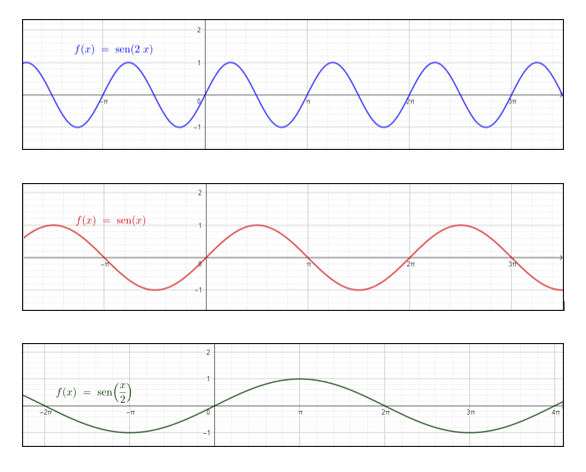
$\left\{ x(t) = \cos (w t ) \atop y(t) = \sin (w t ) \right.$

El periodo es $\frac{2 \pi}{T} = \omega \Rightarrow T = \frac{2 \pi}{\omega}.$

Otro caso:

Si tenemos las ecuaciones $\left\{ x(t) = A \cos (w t ) \atop y(t) = A \sin (w t ) \right.$

y $A = 2$ entonces las ecuaciones

$\left\{ x(t) = 2 \cos (w t ) \atop y(t) = 2 \sin (w t ) \right.$

representan una circunferencia de radio 2. $A$ se denomina amplitud.

Caso centro $(h, k)$

Si el centro está en el punto $(h, k)$, entonces:

$$\left\{ x(t) = A \cos (w t ) + h \atop y(t) = A \sin (w t ) + k \right.$$

En las siguientes ventanas puedes observar una animación de la parametrización. En este caso la curva $\alpha (t) = \Big( 2 \cos (t) , 2 \sin (t) \Big)$