Archivo del Autor: Mariana Perez

61. Material en revisión: Una función con un mínimo

Por Mariana Perez

Dada $f (x , y) = \ln ( 1 + x^2 + y^2 ) $

Analicemos cuando las derivadas parciales valen cero.

$\dfrac{\partial f}{\partial x} = \dfrac{1}{1+x^2+y^2} 2x = 0 \Rightarrow \dfrac{2x}{1+x^2+y^2} = 0 \Rightarrow x = 0$

$\dfrac{\partial f}{\partial y} = \dfrac{1}{1+x^2+y^2} 2y = 0 \Rightarrow \dfrac{2y}{1+x^2+y^2} = 0 \Rightarrow y = 0$

Por lo que el punto $(0, 0)$ es el único punto crítico.

El valor crítico correspondiente es

$f (0, 0) = \ln ( 1 + (0)^2 + (0)^2 ) = \ln (1) = 0$

Segundas derivadas parciales

$\dfrac{\partial^2 f}{\partial x^2} = \dfrac{2 (1 + x^2 + y^2) \, – \, 2x (2x)}{(1 + x^2 + y^2)^2} = \dfrac{2+2x^2+2y^2 \, – \, 4x^2}{(1 + x^2 + y^2)^2} $

Por lo tanto $\dfrac{\partial^2 f}{\partial x^2} = \dfrac{2+2y^2 \, – \, 2x^2}{(1 + x^2 + y^2)^2}$

Luego $f_{xx} (0, 0) = 2$

Análogamente

$\dfrac{\partial^2 f}{\partial y^2} = \dfrac{2 (1 + x^2 + y^2) \, – \, 2y (2y)}{(1 + x^2 + y^2)^2} = \dfrac{2+2x^2+2y^2 \, – \, 4y^2}{(1 + x^2 + y^2)^2} $

Por lo tanto $\dfrac{\partial^2 f}{\partial x^2} = \dfrac{2+2y^2 \, – \, 2y^2}{(1 + x^2 + y^2)^2}$

Luego $f_{yy} (0, 0) = 2$

Además

$\dfrac{\partial^2 f}{\partial y \, \partial x} = \dfrac{2 x(2 y) \, – \, 0}{(1 + x^2 + y^2)^2} = \dfrac{ 4 xy}{(1 + x^2 + y^2)^2} $

Luego $f_{xy} (0, 0) = 0$

Entonces el polinomio de Taylor de 2° grado de $f$ alrededor del punto $( 0, 0)$ es

$$p ( x, y) = \dfrac{1}{2} \big( 2 ( x^2 + y^2 ) \big) = x^2 + y^2 $$

EL punto crítico es NO degenerado, porque el determinante

$$\begin{vmatrix} f_{xx} & f_{xy} \\ \\ f_{xy} & f_{yy} \end{vmatrix} \neq 0$$

Por lo tanto, $f$ alcanza un valor mínimo en $ ( 0, 0).$

Observación:

En coordenadas polares

$$ f ( r, \theta ) = \ln ( 1 + r^2) $$

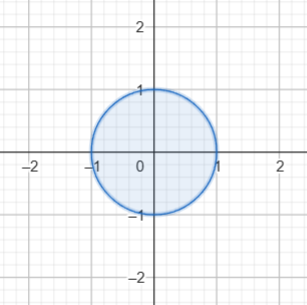
Las curvas de nivel son circunferencias.

(*) Curva de nivel 1

$\big\{ (x, y) \in \mathbb{R}^2 \big| \ln (1+x^2+y^2) = 1 \big\}$

$ 1+x^2+y^2 = e \; \; \iff \; \; x^2+y^2 = e \, – \, 1$ circunferencia de radio $ \sqrt{e \, – \, 1 \, }$

(*) Curva de nivel $\mathcal{c}$ ( con $\mathcal{c} > 1 $) es

$\big\{ (x, y) \in \mathbb{R}^2 \big| \ln (1+x^2+y^2) = \mathcal{c} \big\}$

$ 1+x^2+y^2 = e^{\mathcal{c}} \; \; \iff \; \; x^2+y^2 = e^{\mathcal{c}} \, – \, 1$ circunferencia de radio $ \sqrt{e^{\mathcal{c}} \, – \, 1 \, }$

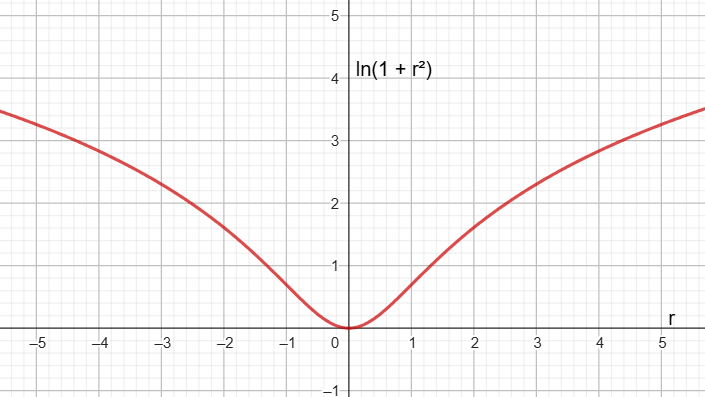
Cerca de $ r = 0 $ , $ \ln ( 1 + r^2) $ se aproxima a su polinomio de Taylor.

$ f (r) = \ln (1+r^2)$

$ f (0) = 0$

$f’ (r) = \dfrac{2r}{1+r^2} $

$ f’ (0) = 0$

${f}^{\prime \prime} (r) = \dfrac{(1+r^2) 2 \, – \, 2r (2r) }{(1+r^2)^2} = \dfrac{2 + 2r^2 \, – \, 4r^2}{(1+r^2)^2} = \dfrac{ 2 \, – \, 2r^2 }{(1+r^2)^2} $

${f}^{\prime \prime} (0) = 2$

$ p (r) = \dfrac{1}{2} 2 r^2 = r^2$

Cerca de $ r = 0$ , $\ln (1+r^2) \approx r^2$

$\ln ( 1+x^2 + y^2) \approx x^2 + y^2 $ cuando $(x , y) $ está cerca del $ ( 0, 0) .$

Lejos de $ r = 0 $, $r$ es grande entonces, $ \ln (1+r^2) \approx \ln (r^2) = 2 \ln r $

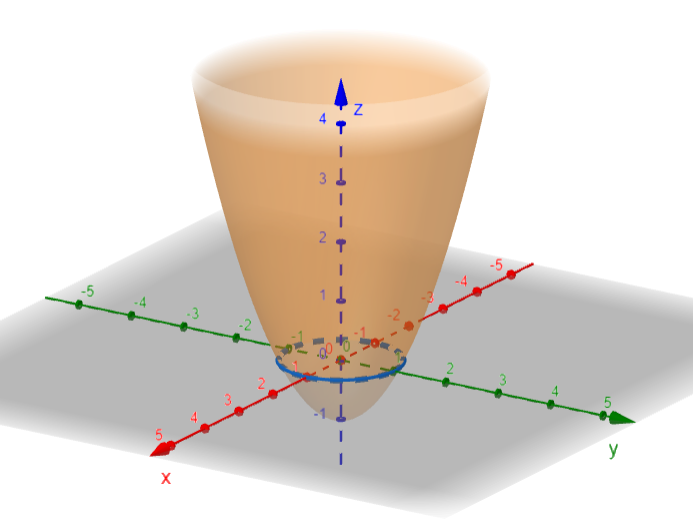
https://www.geogebra.org/classic/wqm6krex

La gráfica de $f$ es $ \big\{ (x, y, z) \in \mathbb{R}^3 \Big| z = \ln (1 + x^2 + y^2) \big\} $ , una superficie de revolución girando la curva $ z = \ln (1 + x^2) $ alrededor del eje $z$.

${}$

60. Material de prueba: Circunferencia osculatriz

Por Mariana Perez

Consideremos una curva parametrizada $$\alpha : I \subseteq \mathbb{R} \rightarrow \mathbb{R}^2$$ $$\alpha (t) = \big( x (t), y (t) \big)$$

Supongamos que $ t = 0 $

$ x ( 0 ) = 0 $

$ y ( 0 ) = 0 $

$\alpha ( 0 ) = ( 0 , 0 )$

Supongamos además que $x $, $ y $ son funciones derivables de $ t $ y que $\big( x’ (t), y’ (t) \big) \neq ( 0, 0) $ vector velocidad.

Llamemos $\vec{v} = \big( x’ (0), y’ (0) \big)$

Consideremos una reparametrización de $\alpha$ $$\beta (s) = \alpha ( h (s) )$$

con $\beta = \alpha \, \circ \, h$, para algún $ h : J \subseteq \mathbb{R} \rightarrow \mathbb{R}$.

Sin pérdida de generalidad, supongamos también $ h (0) = 0$

${\beta \,}’ (s) = \alpha’ ( h (s) ) \cdot h’ ( s )$

${\beta \,}’ (s) = \big( x’ (h (s)), y’ (h (s)) \big) \cdot h’ ( s )$

$\vec{w} = {\beta \,}’ (0) = \big( x’ (0), y’ (0) \big) \cdot h’ (0) = h’ (0) \cdot \vec{v}$

Pedimos que $ h’ (0) \neq 0$

$ \vec{w} $ es el vector velocidad usando $\beta$ como parametrización.

Los dos vectores velocidad $ \vec{v}$ y $\vec{w} $ son colineales. Además, si

$ h’ (0) > 0 $ tienen el mismo sentido, y si

$h’ (0) < 0 $ tienen sentidos contrarios.

${}$

Supongamos que $ \gamma (t) = \big( x (t), y (t) \big)$ es una curva parametrizada, y que $ x (t)$ , $y (t) $ son de clase $\mathcal{C}^2$.

Además

$\gamma’ (0) \neq \vec{0}$

${\gamma}^{\prime \prime} (0) \neq \vec{0}$

Se dice que la circunferencia osculatriz a una curva en un punto $P$ es la circunferencia que más se parece a la curva cerca del punto.

¿Cómo saber cuál es la circunferencia osculatriz en el punto $P$?

Si $\gamma $ estuviera parametrizada por longitud de arco, entonces el centro de la circunferencia osculatriz es $$ \gamma (0) + \dfrac{1}{\mathcal{K} (0)} \vec{n} (0)$$

donde $\vec{n} (0) $ es el vector normal unitario.

Y el radio de la circunferencia osculatriz es $\dfrac{1}{\mathcal{K} (0)}$

Sabiendo la curvatura y el vector normal tenemos toda la información necesaria. (no necesariamente tiene que ser en el punto CERO, puede ser un punto $t_0$ con $\gamma’ (t_0) $ y ${\gamma}^{\prime \prime} (t_0)$ distintas de CERO)

(*) Tenemos una fórmula para calcular $\mathcal{K} (t_0)$

(*) a. En el plano, basta conocer el vector tangente unitario $T (t_0) = \dfrac{ \gamma’ (t_0)}{ \big\| \gamma’ (t_0) \big\|}$. Solo hay dos opciones para $(u, v)$ puede ser $ (- \, v, u ) $ o también $ (v, \, – \, u) $

b. En el espacio

$$ \overrightarrow{N} (t) = \dfrac{\dfrac{d}{dt} \overrightarrow{T} (t) }{\Bigg\| \dfrac{d}{dt} \overrightarrow{T} (t) \Bigg\|}$$

59. Material en revisión: Sobre las derivadas de $g (t) = f (x_0 + th, y_0 + tk)$

Por Mariana Perez

Proposición:

$$ g^{(n)} (t) = \sum\limits_{i=0}^{n} \begin{pmatrix} n \\ i \end{pmatrix} \dfrac{\partial^n f}{\partial x^i \; \partial y^{n-i}} (x_0 + th, y_0 + tk) h^i \; k^{n-i}$$

Demostración (por inducción)

Base inductiva:

Para $n = 1, 2 $ lo trabajamos en la entrada anterior. https://blog.nekomath.com/?p=101046&preview=true

Paso inductivo:

Supongamos la proposición válida para $n.$

$\Big[$ por demostrar: que es válida para $ n + 1 \Big]$

Entonces

$\begin{align*} g^{(n+1)} (t) &= \dfrac{d}{dt} \sum\limits_{i=0}^{n} \begin{pmatrix} n \\ i \end{pmatrix} \dfrac{\partial^n f}{\partial x^{i} \; \partial y^{n-i}} (x_0 + th, y_0 + tk) h^{i} \; k^{n-i} \\ &= \sum\limits_{i=0}^{n} \begin{pmatrix} n \\ i \end{pmatrix} h^{i} \; k^{n-i} \dfrac{d}{dt} \dfrac{\partial^n f}{\partial x^{i} \; \partial y^{n-i}} (x_0 + th, y_0 + tk) \end{align*}$

Podemos ver a la $\dfrac{\partial^n f}{\partial x^{i} \; \partial y^{n-i}} (x, y) = G (x, y)$

Entonces, derivando $G (x_0 + th, y_0 + tk) = G ( \alpha ( t)) $ respecto a $ t $ se tiene que

$\begin{align*}\dfrac{d}{dt} \dfrac{\partial^n f}{\partial x^{i} \; \partial y^{n-i}}& (x_0 + th, y_0 + tk) = \\&= \dfrac{\partial^{n+1} f}{\partial x^{i+1} \; \partial y^{n-i}} (x_0 + th, y_0 + tk) h \, + \, \dfrac{\partial^{n+1} f}{\partial x^{i} \; \partial y^{n-i+1}} (x_0 + th, y_0 + tk) k\end{align*}$

Entonces

$\begin{align*} g^{(n+1)} (t) &= \sum\limits_{i=0}^{n} \begin{pmatrix} n \\ i \end{pmatrix} h^{i} \; k^{n-i} \Bigg( \dfrac{\partial^{n+1} f}{\partial x^{i+1} \; \partial y^{n-i}} (x_0 + th, y_0 + tk) h \, + \, \dfrac{\partial^{n+1} f}{\partial x^{i} \; \partial y^{n-i+1}} (x_0 + th, y_0 + tk) k \Bigg) \end{align*}$ llamemos a esta expresión (1)

$\Big[$ por demostrar: $g^{(n + 1)} (t) = \sum\limits_{i=0}^{n+1} \begin{pmatrix} n+1 \\ i \end{pmatrix} h^{i} \; k^{n+1-i} \dfrac{\partial^{n+1} f}{\partial x^{i} \; \partial y^{n+1-i}} (x_0 + th, y_0 + tk) \Big]$

De $(1)$ tenemos que

$g^{(n+1)} (t) = \sum\limits_{i=0}^{n} \begin{pmatrix} n \\ i \end{pmatrix} h^{i} \; k^{n-i} \dfrac{\partial^{n+1} f}{\partial x^{i+1} \; \partial y^{n-i}} \, + \, \sum\limits_{i=0}^{n} \begin{pmatrix} n \\ i \end{pmatrix} h^{i} \; k^{n+1-i} \dfrac{\partial^{n+1} f}{\partial x^{i} \; \partial y^{n+1-i}} $

haciendo $ j = i + 1$

$g^{(n+1)} (t) = \sum\limits_{j=1}^{n+1} \begin{pmatrix} n \\ j-1 \end{pmatrix} h^{i} \; k^{n+1-i} \dfrac{\partial^{n+1} f}{\partial x^{j} \; \partial y^{n+1-j}} \, + \, \sum\limits_{i=0}^{n} \begin{pmatrix} n \\ i \end{pmatrix} h^{i} \; k^{n+1-i} \dfrac{\partial^{n+1} f}{\partial x^{i} \; \partial y^{n+1-i}} $

con $ i = 0$, $ j = n + 1$

$ g^{(n+1)} (t) = \begin{pmatrix} n \\ 0 \end{pmatrix} h^{0} \; k^{n+1} \dfrac{\partial^{n+1} f}{ \partial y^{n+1}} \, + \, \begin{pmatrix} n \\ n \end{pmatrix} h^{n+1} \; k^{0} \dfrac{\partial^{n+1} f}{\partial x^{n+1} } \, + \, \sum\limits_{i=1}^{n} \Bigg[ \begin{pmatrix} n \\ i-1 \end{pmatrix} , + \, \begin{pmatrix} n \\ i \end{pmatrix} \Bigg] h^{i} \; k^{n+1-i} \dfrac{\partial^{n+1} f}{\partial x^{i} \; \partial y^{n+1-i}} $

entonces

$ g^{(n+1)} (t) = \begin{pmatrix} n \\ 0 \end{pmatrix} h^{0} \; k^{n+1} \dfrac{\partial^{n+1} f}{ \partial y^{n+1}} \, + \, \begin{pmatrix} n \\ n \end{pmatrix} h^{n+1} \; k^{0} \dfrac{\partial^{n+1} f}{\partial x^{n+1} } \, + \, \sum\limits_{i=1}^{n} \begin{pmatrix} n + 1 \\ i \end{pmatrix} h^{i} \; k^{n+1-i} \dfrac{\partial^{n+1} f}{\partial x^{i} \; \partial y^{n+1-i}} $

${}$

(*) Aplicamos el teorema de Taylor a la función $ g (t) = f (x_0 + th, y_0 + tk) $ en $[ 0, 1]$

Teorema de Taylor en una variable

$f (x) = f (a) + f’ (a) (x\, – \, a) + \dfrac{ {f’}’ (a)}{2} (x\, – \, a)^2 \, + \, R_2 (x)$

Fórmulas para $R_2 (x)$

(1) Lagrange: $R_2 (x) = \dfrac{ f^{(3)} (t) }{3!} (x\, – \, a)^3$ para algún $ t \in ( a, x)$.

(2) Integral: $ \begin{equation*}R_2 (x) =\int\limits_{a}^{x} \dfrac{ f^{(3)} (t) }{2!} (x\, – \, a)^2 dt\end{equation*}$

Si $[a, x] = [0, 1]$ entonces $ x \, – \, a = 1$, por lo que

$ g (1) = g (0) \, + \, g’ (0) \, + \, \dfrac{ {g’}’ (0) }{2!} \, + \, R_2 (1)$

Si $(x_0, y_0)$ es un punto crítico, entonces

$f (x_0 + h, y_0 + k) = f (x_0 , y_0) \, + \, \cancel{\dfrac{\partial f}{\partial x} (x_0, y_0) h } \, + \, \cancel{ \dfrac{\partial f}{\partial y} (x_0, y_0) k} \, + \, \dfrac{1}{2} \Bigg[ \textcolor{Magenta}{\dfrac{\partial^2 f}{\partial x^2} (x_0, y_0) h^2 \, + \, 2 \dfrac{\partial^2 f}{\partial x \; \partial y} (x_0, y_0) h\, k \, + \, \dfrac{\partial^2 f}{\partial y^2} (x_0, y_0) k^2} \Bigg] \, + \, R_2 (1) $

La expresión resaltada de color se conoce como $\textcolor{Magenta}{Forma \; \; cuadr\acute{a}tica}.$

Calculamos el error con cualquiera de las dos fórmulas vistas, de modo que:

(1) $\dfrac{g^{(3)} (t)}{3!} = \dfrac{1}{3!} \Bigg( \dfrac{ \partial f^{(3)}}{\partial x^3} h^3 \, + \, 3 \dfrac{\partial^3 f}{\partial x^2 \; \partial y} h^2 \; k \, + \, 3 \dfrac{\partial^3 f}{\partial x \; \partial y^2} h \; k^2 \, + \, \dfrac{ \partial f^{(3)}}{\partial y^3} k^3 \Bigg)$ en $ t \in (0, 1) $

(2) $\begin{equation*}\int\limits_{0}^{1} \dfrac{g^{(3)} (t)}{2} (1 \, – \, t)^2 dt \end{equation*}_{\blacksquare}$

58. Material de prueba: Derivadas direccionales iteradas y teorema del valor medio para la derivada.

Por Mariana Perez

Sea $ f : U \subseteq \mathbb{R}^2 \rightarrow \mathbb{R}$ , diferneciable en un abierto, convexo $ U. $

Sea $ (x_0, y_0) \in U$ y $ (h, k) $ cercano a $ (x_0, y_0) $, tal que $(x_0 + h , y_0 + k) \in U.$

Como $ U $ es convexo, entonces $$ (1 \, – \,t) (x_0, y_0) + t ( x_0 + h , y_0 + k) = (x_0 + t h , y_0 + t k) \in U$$

Podemos parametrizar el segmento de recta $ \alpha (t) = (x_0 + t h, y_0 + t k) $ y hacer la composición $ f \, \circ \, \alpha : [ 0, 1] \rightarrow \mathbb{R}$

Le podemos aplicar:

(*) el teorema del valor medio para funciones de $\mathbb{R} \rightarrow \mathbb{R}$, y también

(*) la regla de la cadena.

${}$

Teorema del valor medio para derivadas

Si $ g $ es continua en el cerrado $[0, 1]$ y derivable en el abierto $(0, 1)$, entonces existe $\theta \in (0, 1) $ tal que

$$g’ (\theta) = \dfrac{g (1) \, – \, g (0) }{1 \, – \, 0} = g (1) \, – \, g (0) $$

donde $ g = f \, \circ \, \alpha$

$ ( f \, \circ \, \alpha ) (\theta) = \nabla f ( \alpha ( \theta )) \cdot {\alpha}’ (\theta) = \dfrac{\partial f}{\partial x} (x_0 + \theta h , y_0 + \theta k) h \, + \, \dfrac{\partial f}{\partial y} (x_0 + \theta h , y_0 + \theta k) k$

Sabemos que

$ f (x_0 + h , y_0 + k) = f (x_0 , y_0) + \nabla f ( \alpha ( \theta )) \cdot {\alpha}’ (\theta) $

$ f (x_0 + h , y_0 + k) \, – \, f (x_0 , y_0) = \nabla f ( \alpha ( \theta )) \cdot {\alpha}’ (\theta) $

Si $ f $ fuera de clase $\mathcal{C}^2$ podríamos decir más, en particular $ g = f \, \circ \, \alpha \in \mathcal{C}^2$

$g (t) = f ( x_0 + t h, y_0 + t k)$

$g’ (t) = \dfrac{\partial f}{\partial x} ( x_0 + t h, y_0 + t k) h \, + \, \dfrac{\partial f}{\partial y} ( x_0 + t h, y_0 + t k) k$

Queremos calcular $ {g}^{\prime \prime} (t)$.

Examinemos $\dfrac{\partial f}{\partial x} ( x_0 + t h, y_0 + t k) = G ( x_0 + t h, y_0 + t k)$

Sea $G (x, y) = \dfrac{\partial f}{\partial x} (x, y)$, entonces

$ \dfrac{d}{dt} G ( x_0 + t h, y_0 + t k) = \dfrac{\partial G}{\partial x} ( x_0 + t h, y_0 + t k) h \, + \, \dfrac{\partial G}{\partial y}( x_0 + t h, y_0 + t k) k$

Entonces

$$ {g}^{\prime \prime} (t) = \Bigg( \dfrac{\partial^2 f}{\partial x^2} ( x_0 + t h, y_0 + t k) h \, + \, \dfrac{\partial f}{\partial y \partial x} ( x_0 + t h, y_0 + t k) k \Bigg) h \, + \, \Bigg( \dfrac{\partial f}{\partial x \partial y} ( x_0 + t h, y_0 + t k) h \, + \, \dfrac{\partial^2 f}{\partial y^2} ( x_0 + t h, y_0 + t k) k \Bigg) k$$

$${g}^{\prime \prime}(t) = \dfrac{\partial^2 f}{\partial x^2} ( x_0 + t h, y_0 + t k) h^2 \, + \, 2 \dfrac{\partial^2 f}{\partial y \partial x} ( x_0 + t h, y_0 + t k) h k \, + \, \dfrac{\partial^2 f}{\partial y^2} ( x_0 + t h, y_0 + t k) k^2 $$

${g}^{\prime \prime}(t) $ es la segunda derivada de $ ( f \, o \, \alpha) ( t ).$

La tercera derivada de $ f ( \alpha ( t ) )$ es $$ \dfrac{\partial^3 f}{\partial x^3} h^3 \, + \, 3 \dfrac{\partial^3 f}{\partial x^2 \partial y} h^2 k \, + \, 3 \dfrac{\partial^3 f}{\partial x \partial y^2} h k^2 \, + \, \dfrac{\partial^3 f}{\partial y^3} k^3 $$ valuada en $( x_0 + t h, y_0 + t k)$

${}$

Teorema de Taylor para funciones de $\mathbb{R} \rightarrow \mathbb{R}$ aplicado a $ g = f \, \circ \, \alpha$

$g ( t ) = g ( 0 ) + g’ ( 0 ) t + \frac{1}{2} {g}^{\prime \prime} ( 0 ) t^2 + E ( t )$ , donde $ E ( t )$ es el error.

Una fórmula para este error es $ \dfrac{{g}^{\prime \prime \prime} ( \xi ) }{ 3! } $ para alguna $ \xi \in ( 0, t)$

Entonces

$ g ( t ) = f ( x_0 + t h, y_0 + t k)$

$ g ( 0 ) = f ( x_0 , y_0 )$

$ g’ ( 0 ) = \dfrac{\partial f}{\partial x} ( x_0 , y_0 ) h + \dfrac{\partial f}{\partial y} ( x_0 , y_0 ) k$

$ {g}^{\prime \prime} ( 0 ) = \dfrac{\partial^2 f}{\partial x} ( x_0 , y_0 ) h^2 + 2 \dfrac{\partial^2 f}{\partial y \partial x} ( x_0 , y_0 ) h k + \dfrac{\partial^2 f}{\partial y^2} ( x_0 , y_0 ) k^2 $

$ \dfrac{{g}^{\prime \prime \prime} ( \xi)}{3!} = \dfrac{\dfrac{\partial^3 f}{\partial x^3} (x_0 + \xi h, y_0 + \xi k ) h^3 \, + \, 3 \dfrac{\partial^3 f}{\partial x^2 \partial y} (x_0 + \xi h, y_0 + \xi k ) h^2 k \, + \, 3 \dfrac{\partial^3 f}{\partial x \partial y^2} (x_0 + \xi h, y_0 + \xi k ) h k^2 \, + \, \dfrac{\partial^3 f}{\partial y^3} (x_0 + \xi h, y_0 + \xi k )}{3!} $

Si $f $ es de clase $\mathcal{C}^3$ ya tenemos un polinomio de 2° grado que aproxima bien a $f$ localmente.

Si el punto es un $\textit{ punto crítico }$ entonces, el polinomio de 2° grado es, esencialmente, un polinomio homogéneo.

$ p (x, y) = ax^2 + 2bxy + cy^2 $

$ p ( 0, 0 ) = 0$

El vector gradiente $ \nabla p ( 0, 0) = \Big( \dfrac{\partial p }{\partial x} , \dfrac{\partial p }{\partial y} \Big) \Biggm|_{(0, 0)} = ( 2ax + 2 by, 2 bx + 2 cy ) \Biggm|_{(0, 0)} = (0, 0)$

El plano tangente a $ z = p (x, y )$ en el origen es horizontal.

Observación:

La matriz $ A = \begin{equation*} \begin{pmatrix} a & b \\ b & c \end{pmatrix} \end{equation*}$ es simétrica.

También sabemos que si la matriz es diagonalizable, entonces existe una base ortonormal de vectores propios $\vec{v_1}, \, \vec{v_2}$ tales que

$\| \vec{v_1} \| = \| \vec{v_2} \| = 1$ y también $ \vec{v_1} \cdot \vec{v_2} = 0$

Y existe $\theta$ tal que

$ \vec{v_1} = (\cos \theta , \sin \theta ) $

$ \vec{v_2} = (\, – \ \sin \theta, \cos \theta) $

Además, existen $\lambda_1 , \, \lambda_2$ tales que $$ A \vec{v_1} = \lambda_1 \vec{v_1} $$ $$ A \vec{v_2} = \lambda_2 \vec{v_2} $$

$D = \begin{equation*} \begin{pmatrix} \lambda_1 & 0 \\ 0 & \lambda_2 \end{pmatrix} \end{equation*}$ es la matriz diagonal.

Sin pérdida de generalidad en al caso cuando

$\begin{equation*} \begin{pmatrix} a & b \\ b & c \end{pmatrix} = \begin{pmatrix} \lambda_1 & 0 \\ 0 & \lambda_2 \end{pmatrix} \end{equation*}$

$ p (x, y) = \lambda_1 x^2 + \lambda_2 y^2$

Analicemos los tres casos posibles según los valores de $\lambda$

CASO 1: $ \lambda_1 , \lambda_2 > 0$ entonces, $p$ alcanza un valor mínimo.

https://www.geogebra.org/classic/drtwmcwt

Ejemplo: $p (x, y) = x^2 + y^2 $

CASO 2: $ \lambda_1 , \lambda_2 < 0$ entonces, $p$ alcanza un valor máximo.

https://www.geogebra.org/classic/zkkwuga4

Ejemplo: $p (x, y) = \, – \, x^2 \, – \, y^2 $

CASO 3: $ \lambda_1 > 0 , \lambda_2 < 0$ entonces, $p$ tiene un punto silla.

https://www.geogebra.org/classic/yczbtnvb

Ejemplo: $p (x, y) = x^2 \, – \, y^2 $

Si alguno de los $\lambda$ es CERO, no se puede concluir nada acerca del punto.

${}$

$\underline{\textit{Veamos un ejemplo}}:$

$p (x, y) = 2xy$

Como $ p (x, y) = ax^2 + 2bxy + cy^2$ entonces, para nuestro ejemplo tenemos que:

$ a = 0$ , $ b = 1$ , y $ c = 0$.

Entonces la matriz $A = \begin{equation*} \begin{pmatrix} 0 & 1 \\ 1 & 0 \end{pmatrix} \end{equation*}$

Entonces $\begin{equation*} \begin{vmatrix} – \, \lambda & 1 \\ 1 & – \, \lambda \end{vmatrix} \end{equation*} = 0$

$ \lambda^2 \, – \, 1 = 0 $

$ \lambda^2 = 1$ y por tanto $ \lambda = \pm 1$

$\underline{\textit{Vectores propios}}:$

$$\begin{equation*} \begin{pmatrix} 0 & 1 \\ 1 & 0 \end{pmatrix} \begin{pmatrix} x \\ y \end{pmatrix} = 1 \begin{pmatrix} x \\ y \end{pmatrix} \end{equation*}$$

Entonces

$$\begin{equation*} \begin{pmatrix} y \\ x \end{pmatrix} = \begin{pmatrix} x \\ y \end{pmatrix} \end{equation*}$$

Luego $ \vec{v_1} = \dfrac{( 1, 1)}{ \| \vec{v_1} \|} = \begin{pmatrix} \dfrac{1}{\sqrt{2}} \\ {} \\ \dfrac{1}{\sqrt{2}} \end{pmatrix} = \begin{pmatrix} \cos \dfrac{\pi}{4} \\ {} \\ \sin \dfrac{\pi}{4} \end{pmatrix}$

Análogamente,

$$\begin{equation*} \begin{pmatrix} 0 & 1 \\ 1 & 0 \end{pmatrix} \begin{pmatrix} x \\ y \end{pmatrix} = \, – \, 1 \begin{pmatrix} x \\ y \end{pmatrix} \end{equation*}$$

Entonces

$$\begin{equation*} \begin{pmatrix} y \\ x \end{pmatrix} = \begin{pmatrix} \, – \, x \\ \, – \, y \end{pmatrix} \end{equation*}$$

Luego $ \vec{v_2} = \begin{pmatrix} \dfrac{ \, – \, 1}{\sqrt{2}} \\ {} \\ \dfrac{ \, – \, 1}{\sqrt{2}} \end{pmatrix} = \begin{pmatrix} \, – \, \sin \dfrac{\pi}{4} \\ {} \\ \cos \dfrac{\pi}{4} \end{pmatrix}$

${}$

Corte con el plano vertical $ x = y$ son las parábolas $p (x, y) = 2x^2$

Corte con el plano vertical $ y = \, – \, x$ son las parábolas $p (x, y) = \, – \, 2x^2$

En el siguiente enlace puedes observar la gráfica de la superficie $p (x,y)$ y sus cortes con los planos verticales.

57. Material de prueba: Máximos y mínimos. Teorema de Taylor

Por Mariana Perez

Recordemos que para funciones $f : \mathbb{R} \rightarrow \mathbb{R}$, si $f$ alcanza un valor máximo, o un valor mínimo, en $ x_0 $ y $f $ es derivable en $x_0$ entonces, $f’ (x_0) = 0.$ Ahora tendremos:

Si $f : \mathbb{R}^n \rightarrow \mathbb{R}$ alcanza un valor máximo, o mínimo, en $\vec{x_0}$ y $f$ es diferenciable entonces $$ \nabla f (\vec{x_0}) = \Big( \dfrac{\partial f}{\partial x_1} (x_0), \dfrac{\partial f}{\partial x_2} (x_0), \dots , \dfrac{\partial f}{\partial x_n} (x_0)\Big) = \vec{0}$$

Equivalentemente, la diferencial de $f$ en $\vec{x_0}$ es $d f (\vec{x_0}) : \mathbb{R}^n \rightarrow \mathbb{R}$ es la función constante CERO.

Geométricamente: Si $ f : \mathbb{R}^2 \rightarrow \mathbb{R} $, entonces el plano tangente a la superficie $ z = f (x, y) $ en el punto $(x_0, y_0, z_0)$ donde se alcanza el valor extremo es horizontal.

Tenemos las siguientes generalizaciones:

Si $f : \mathbb{R}^2 \rightarrow \mathbb{R} $ y $\vec{x_0} \in \mathbb{R}^n$ es un punto crítico de $f$ si $\nabla f (\vec{x_0}) = \vec{0}$, es decir, si $ d f_{\vec{x_0}} \equiv 0.$

(*) $y_1 \in \mathbb{R}$ es un valor regular si $ f^{-1} (y_1) $ es un conjunto que no contiene ningún punto crítico.

(*) $f : \mathbb{R} \rightarrow \mathbb{R} $ curva parametrizada es regular si $f’ (t) \neq \vec{0}$ para toda $t$, $t_0$ es un punto crítico si $f’ (t_0) = \vec{0}.$

(*) $f : \mathbb{R}^n \rightarrow \mathbb{R}^m $ y $\vec{x_0} \in \mathbb{R}^n$ es un punto crítico si $d f_{\vec{x_0}} : \mathbb{R}^n \rightarrow \mathbb{R}^m$ tiene el rango igual al máximo posible.

${}$

Derivadas parciales iteradas (mixtas)

Sea $f : U \subseteq \mathbb{R}^2 \rightarrow \mathbb{R}$ con $U$ abierto, y $(x_0, y_0) \in U.$

Supongamos que existen

$\dfrac{ \partial f}{ \partial x} : U \subseteq \mathbb{R}^2 \rightarrow \mathbb{R}$

$\dfrac{ \partial f}{ \partial y} : U \subseteq \mathbb{R}^2 \rightarrow \mathbb{R}$

Conceptualmente

$\dfrac{ \partial }{ \partial y } \dfrac{ \partial f}{ \partial x}$ y $ \dfrac{ \partial }{ \partial x } \dfrac{ \partial f}{ \partial y}$ podrían ser diferentes.

Veamos un ejemplo:

Consideremos la función $ f : \mathbb{R}^2 \rightarrow \mathbb{R}$

$\begin{equation*} f (x, y) = \begin{cases} \dfrac{xy ( x^2 \, – \, y^2) }{x^2 + y^2} & \text{ si } (x, y) \neq (0, 0) \\ {} \\ 0 & \text{ si } (x, y) = (0, 0) \end{cases} \end{equation*}$

Afirmación: existen las derivadas parciales $\dfrac{ \partial }{ \partial y } \dfrac{ \partial f}{ \partial x} \Biggm|_{(0, 0)} $, $\dfrac{ \partial }{ \partial x } \dfrac{ \partial f}{ \partial y} \Biggm|_{(0, 0)} $, y son diferentes.

Veamos como calcular el siguiente límite.

Tenemos que:

$\dfrac{ \partial }{ \partial y } \dfrac{ \partial f}{ \partial x} \Biggm|_{(0, 0)} = \lim\limits_{k \to 0} \dfrac{ \dfrac{ \partial f}{ \partial x} (0, k) \, – \, \dfrac{ \partial f}{ \partial x} (0, 0) }{k} $ , llamaremos a esta expresión (1).

Para calcular esto necesitamos calcular primero las siguientes derivadas parciales:

$\dfrac{ \partial f}{ \partial x} (0, 0) = \lim\limits_{h \to 0} \dfrac{f (h, 0) \, – \, f (0, 0)}{h} = 0$

También necesitamos calcular

$\begin{align*} \dfrac{ \partial f}{ \partial x} (0, k) &= \lim\limits_{h \to 0} \dfrac{f (h, k) \, – \, f (0, k)}{h} \\ &= \lim\limits_{h \to 0} \dfrac{\dfrac{\cancel{h}k (h^2 \, – \, k^2)}{h^2 + k^2} \, – \, 0}{\cancel{h}} \\ &= \lim\limits_{h \to 0} \dfrac{k (h^2 \, – \, k^2)}{h^2 + k^2} \\ &= – \, \dfrac{k^3}{k^2} \\ \\ \dfrac{\partial f}{\partial x} (0, k) &= – \, k \end{align*}$

Entonces la expresión (1) queda de la siguiente manera:

$\dfrac{ \partial }{ \partial y } \dfrac{ \partial f}{ \partial x} \Biggm|_{(0, 0)} = \lim\limits_{k \to 0} \dfrac{ – \, k \, – \, 0 }{k} = \lim\limits_{k \to 0} – \, 1 = – \, 1$

Análogamente, para calcular

$\dfrac{ \partial }{ \partial x } \dfrac{ \partial f}{ \partial y} \Biggm|_{(0, 0)} = \lim\limits_{h \to 0} \dfrac{ \dfrac{ \partial f}{ \partial y} (h, 0) \, – \, \dfrac{ \partial f}{ \partial y} (0, 0) }{h} $ , llamaremos a esta expresión (2).

Calculemos primero las siguientes derivadas parciales:

$\dfrac{ \partial f}{ \partial y} (0, 0) = \lim\limits_{k \to 0} \dfrac{f (0, k) \, – \, f (0, 0)}{k} = \lim\limits_{k \to 0} \dfrac{0}{k} = 0$

y también

$\begin{align*} \dfrac{ \partial f}{ \partial y} (h, 0) &= \lim\limits_{k \to 0} \dfrac{f (h, k) \, – \, f (h, 0)}{k} \\ &= \lim\limits_{k \to 0} \dfrac{\dfrac{h \cancel{k} (h^2 \, – \, k^2)}{h^2 + k^2} \, – \, 0}{\cancel{k}} \\ &= \lim\limits_{k \to 0} \dfrac{h (h^2 \, – \, k^2)}{h^2 + k^2} \\ &= \dfrac{h^3}{h^2} \\ \\ \dfrac{\partial f}{\partial y} (h, 0) &= h \end{align*}$

Entonces la expresión (2) queda de la siguiente manera:

$\dfrac{ \partial }{ \partial x } \dfrac{ \partial f}{ \partial y} \Biggm|_{(0, 0)} = \lim\limits_{h \to 0} \dfrac{ h \, – \, 0 }{h} = \lim\limits_{k \to 0} 1 = 1$

De lo anterior, podemos observar que las derivadas parciales existen y son diferentes.

${}$

Entonces, quizás te preguntes, ¿existen funciones tales que sus derivadas parciales iteradas (o mixtas) sean iguales?; ¿cuáles son las funciones para las cuales sus derivadas parciales iteradas (o mixtas) son iguales?

Para responder a estas preguntas tenemos el siguiente teorema.

${}$

Teorema (de Fubini)

Si $ f $ es de clase $\mathcal{C}^2$ (es decir, que las segundas derivadas existen y son continuas) entonces las derivadas parciales iteradas ( o mixtas) son iguales.

Sea $ f : U \subset \mathbb{R}^2 \rightarrow \mathbb{R}$ donde $U$ es abierto, y $(x_0, y_0) \in U$ entonces $$ \dfrac{\partial^2 f }{\partial y \partial x} (x_0, y_0) = \dfrac{\partial^2 f }{\partial x \partial y} (x_0, y_0)$$

Demostración:

Definamos $ A = f (x_0 + h, y_0 + k) \, – \, f (x_0 + h, y_0 ) \, – \, f (x_0 , y_0 + k) \, + \, f (x_0 , y_0 ) = g (x_0 + h) \, – \, g (x_0)$

Si $g (x , y_0 + k) \, – \, f (x, y_0)$, fijando $y_0, k$ tenemos que $g (x) = \dfrac{\partial f}{\partial y} (x, y_0 + \theta k) k $ con $ 0 < \theta < 1$.

Entonces

$\dfrac{\partial g}{\partial x} (x_0 + \eta h) h $ y por tanto

$ A = \dfrac{\partial }{\partial x} \dfrac{\partial f}{\partial y} (x_0 + \eta h, y_0 + \theta k) h k $

Por otra parte $A$ también puede verse como una resta de valores de otra función $G$.

$A = G ( y_0 + k) \, – \, G (y_0) $ , donde $ G (y) = f ( x_0 + h, y ) \, – \, f (x_0, y)$

Fijando $x_0 , h$

$ G ( y_0 + k) = f ( x_0 + h, y_0 + k ) \, – \, f (x_0, y_0 + k )$, y por otro lado

$G (y_0) = f ( x_0 + h, y_0 ) \, – \, f (x_0, y_0 )$

Luego

$ G ( y_0 + k) \, – \, G (y_0) = f ( x_0 + h, y_0 + k ) \, – \, f (x_0, y_0 + k ) \, – \, f ( x_0 + h, y_0 ) \, + \, f (x_0, y_0 )$

Además

$G’ ( y_0 + \hat{\theta} k) = \dfrac{G (y_0 + k) \, – \, G(y_0)}{k}$

$ k G’ ( y_0 + \hat{\theta} k) = G (y_0 + k) \, – \, G(y_0) $

Entonces

$\begin{align*} A &= G ( y_0 + k) \, – \, G (y_0) \\ &= \dfrac{ \partial G}{\partial y} (y_0 + \hat{\theta} k ) k \\ &= \Big( \dfrac{ \partial f}{\partial y} (x_0 + h , y_0 + \hat{\theta} k) k \, – \, \dfrac{ \partial f}{\partial y} (x_0 , y_0 + \hat{\theta} k) k \Big) \\ &= \dfrac{ \partial }{\partial y} \dfrac{ \partial f}{\partial y} (x_0 + \hat{\eta} h , y_0 + \hat{\theta} k) h k \end{align*}$

Entonces $ \dfrac{A}{h k} = \dfrac{ \partial }{\partial y} \dfrac{ \partial f}{\partial y} (x_0 + \hat{\eta} h , y_0 + \hat{\theta} k)$

Luego

$\lim\limits_{(h, k) \to (0, 0)} \dfrac{A}{h k} = \lim\limits_{(h, k) \to (0, 0)} \Bigg[ \dfrac{\partial^2 f}{\partial y \partial x} (x_0 + \hat{\eta} h , y_0 + \hat{\theta} k) \Bigg] = \dfrac{\partial^2 f}{\partial y \partial x} (x_0, y_0) \; \; \; _{\blacksquare}$

${}$

Teorema de Taylor ( 1° grado)

Sea $ f : U \subseteq \mathbb{R}^n \rightarrow \mathbb{R} $ , de clase $\mathcal{C}^2$ , diferenciable en $ \vec{x_0} \in U$ abierto. Entonces $$ f (\vec{x_0} + \vec{h} ) = f (\vec{x_0}) + \nabla f (\vec{x_0}) \cdot \vec{h} + R_1 (\vec{x_0}, \vec{h})$$

donde $\; \; \lim\limits_{\vec{h} \to \vec{0}} \dfrac{R_1 (\vec{x_0}, \vec{h})}{ \big\| \vec{h} \big\|} = 0$

Teorema de Taylor ( 2° grado)

Sea $ f : U \subseteq \mathbb{R}^n \rightarrow \mathbb{R} $ , de clase $\mathcal{C}^3.$ Entonces $$ f (\vec{x_0} + \vec{h} ) = f (\vec{x_0}) + \sum\limits_{i = 1}^{n} h_i \dfrac{\partial f}{\partial x_i} \vec{x_0} + \frac{1}{2} \sum\limits_{i, j = 1}^{n} h_i h_j \dfrac{\partial^2 f}{\partial x_i \partial x_j} \vec{x_0} + R_2 (\vec{x_0}, \vec{h})$$

tal que $\; \; \lim\limits_{\vec{h} \to \vec{0}} \dfrac{R_2 (\vec{x_0}, \vec{h})}{ \big\| \vec{h} \big\|^2 } = 0$ , y $ \vec{h} = (h_1 , h_2 , \cdots , h_n ).$